Author: Guillaume Mariani
AI tool: ChatGPT (OpenAI)
Date: May 2026
Arc 1: The Birth of a Framework
Abstract
Artificial intelligence is reshaping the foundations of business, work, management, governance, education, and society. Yet the rise of intelligent machines does not imply the disappearance of human leadership. On the contrary, the AI revolution is increasing the strategic importance of uniquely human capabilities that cannot easily be automated: emotional understanding, cultural interpretation, political navigation, ethical judgment, adaptive learning, interdisciplinary thinking, and meaning-making.
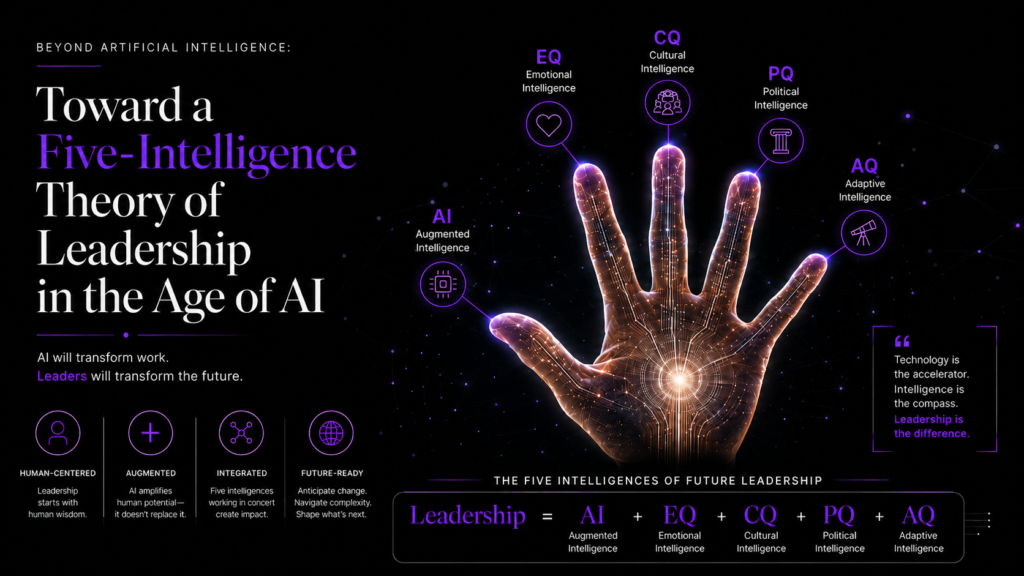
This article proposes a new interdisciplinary leadership architecture for the age of AI: the Five Intelligences of Future Leadership. The framework argues that future leadership effectiveness will depend on the integration of five complementary forms of intelligence: Augmented Intelligence (AI), Emotional Intelligence (EQ), Cultural Intelligence (CQ), Political Intelligence (PQ), and Adaptive Intelligence (AQ).
The framework is represented symbolically through the five fingers of the human hand. Augmented Intelligence is the thumb, Emotional Intelligence the index finger, Cultural Intelligence the middle finger, Political Intelligence the ring finger, and Adaptive Intelligence the little finger. Like the fingers of the hand, each intelligence has a distinct function, but leadership effectiveness emerges from their coordinated interaction.
The proposed formula is:
Leadership = AI + EQ + CQ + PQ + AQ
The article argues that leadership in the age of AI is no longer reducible to technical expertise, managerial authority, or analytical reasoning alone. Instead, future leadership requires the ability to combine technological augmentation with emotional connection, cultural fluency, political legitimacy, and adaptive judgment.
The article also develops several conceptual integrations. Cognitive and complexity intelligence are integrated into Augmented Intelligence; judgment intelligence is integrated into Adaptive Intelligence; and purpose intelligence is integrated into Political Intelligence. The result is a parsimonious yet comprehensive leadership framework capable of bridging technology, management, organizational behavior, strategy, social sciences, humanities, and future studies.
The framework contributes to leadership theory by proposing a human-centered model of leadership adapted to the conditions of technological acceleration, organizational complexity, geopolitical uncertainty, and societal transformation. It also argues for the renewed relevance of soft skills, interdisciplinarity, humanities education, and social sciences in the AI era.
Keywords: artificial intelligence; augmented intelligence; emotional intelligence; cultural intelligence; political intelligence; adaptive intelligence; leadership theory; future leadership; AI leadership; human-AI collaboration; interdisciplinary leadership; digital transformation; systems thinking; complexity leadership; organizational resilience; adaptive leadership; leadership development; AI governance; organizational behavior; future of work.
Introduction
The twenty-first century is witnessing one of the most profound technological transformations in human history. Artificial intelligence is no longer confined to laboratories, science fiction, or narrow technical applications. It now influences finance, healthcare, education, military strategy, public administration, journalism, marketing, entertainment, law, scientific research, and corporate decision-making. Large language models, generative AI systems, autonomous algorithms, and predictive analytics are transforming the structure of work and redefining the relationship between humans and machines.
This transformation has generated both excitement and anxiety. Some analysts predict unprecedented productivity gains, scientific breakthroughs, and economic growth. Others fear mass unemployment, social fragmentation, algorithmic domination, ethical crises, and the obsolescence of human labor.
Within this context, a fundamental question emerges:
What will leadership mean in the age of AI?
Classical leadership models were developed during industrial or post-industrial periods characterized by relatively stable organizational structures, hierarchical institutions, and slower technological cycles. Many traditional leadership theories focused on authority, charisma, strategy, efficiency, rational planning, or managerial control. However, the contemporary environment is increasingly defined by volatility, complexity, technological acceleration, globalization, information overload, geopolitical fragmentation, and permanent transformation.
In this context, leadership can no longer be reduced to technical competence or analytical intelligence alone.
Paradoxically, the more technologically advanced society becomes, the more valuable deeply human capacities become. As artificial intelligence systems become increasingly capable of automating routine cognitive tasks, human differentiation shifts toward areas that machines still struggle to reproduce fully: emotional understanding, contextual interpretation, cultural navigation, ethical reasoning, collective meaning-making, strategic judgment, political legitimacy, and adaptive learning.
The age of AI therefore does not eliminate the relevance of human leadership. It transforms it.
This article proposes a new framework for understanding leadership under these conditions: the Five Intelligences of Future Leadership.
The framework argues that effective leadership in the age of AI requires the integration of five complementary forms of intelligence:
- AI: Augmented Intelligence
- EQ: Emotional Intelligence
- CQ: Cultural Intelligence
- PQ: Political Intelligence
- AQ: Adaptive Intelligence
Together, these five intelligences form a comprehensive leadership architecture capable of integrating technology, humanity, complexity, diversity, institutions, and change.
The framework is visually represented through the metaphor of the human hand. The five intelligences correspond symbolically to the five fingers:
- Augmented Intelligence (AI) = Thumb
- Emotional Intelligence (EQ) = Index Finger
- Cultural Intelligence (CQ) = Middle Finger
- Political Intelligence (PQ) = Ring Finger
- Adaptive Intelligence (AQ) = Little Finger
The hand metaphor is not merely aesthetic. It reflects several conceptual assumptions:
- Leadership requires coordination between multiple complementary capacities.
- No single intelligence is sufficient in isolation.
- Human leadership remains embodied, relational, and contextual.
- The future belongs not to machine intelligence alone, but to augmented human intelligence.
- Adaptability and dexterity are central leadership capabilities in periods of uncertainty.
Like the fingers of a hand, each intelligence performs a distinct function, yet all must work together to produce effective action.
The central proposition of this article is therefore the following:
Leadership in the age of AI is the capacity to integrate augmented, emotional, cultural, political, and adaptive intelligences in order to navigate complexity, mobilize collective action, and sustain human relevance in technologically accelerated societies.
The Limits of Traditional Leadership Models
Many traditional leadership theories emerged during periods in which organizations were relatively hierarchical, predictable, and geographically bounded. Classical managerial approaches emphasized efficiency, optimization, specialization, and control.
Although these models contributed significantly to organizational theory, they increasingly struggle to address contemporary realities characterized by:
- technological disruption,
- interdisciplinary complexity,
- global interdependence,
- remote and hybrid work,
- algorithmic decision-making,
- geopolitical instability,
- cultural fragmentation,
- ecological uncertainty,
- and accelerating change.
Traditional leadership models also often privilege analytical or technical intelligence while underestimating the importance of emotional, cultural, adaptive, and political capacities.
The AI revolution intensifies this limitation.
As machines become increasingly capable of performing data processing, optimization, forecasting, and analytical tasks, purely technical forms of expertise become progressively commoditized. The comparative advantage of human leaders therefore shifts toward forms of intelligence that remain deeply contextual, relational, ethical, interpretive, and adaptive.
Leadership in the age of AI thus requires a transition from command-and-control logic toward integrative and interdisciplinary intelligence.
The Five Intelligences framework emerges from this transition.
Leadership as Augmentation Rather Than Replacement
One of the central misconceptions surrounding AI is the assumption that human and machine intelligence exist in a zero-sum relationship. According to this deterministic view, the rise of artificial intelligence necessarily implies the decline of human relevance.
This article rejects that assumption.
The future of leadership is not based on artificial intelligence replacing human intelligence. It is based on augmented intelligence: the strategic integration of human and machine capabilities.
Augmented Intelligence refers to the ability to collaborate effectively with intelligent technologies while preserving and amplifying uniquely human capacities.
The distinction is essential.
Artificial intelligence emphasizes machines.
Augmented intelligence emphasizes humans enhanced by technology.
This shift has profound implications for leadership theory.
The leaders of the future will not necessarily be those who possess the highest raw analytical capacity. Instead, they will be those capable of:
- leveraging AI systems intelligently,
- synthesizing information across disciplines,
- exercising judgment under uncertainty,
- understanding human emotions,
- navigating cultural diversity,
- managing institutional complexity,
- and adapting continuously to change.
The Five Intelligences framework therefore positions technology as an amplifier of human capability rather than a substitute for humanity.
The Five Intelligences of Future Leadership
1. Augmented Intelligence (AI)
Definition
Augmented Intelligence is the ability to understand, integrate, and strategically leverage intelligent technologies while combining them with human cognitive, ethical, and interdisciplinary capacities.
Augmented Intelligence expands the traditional meaning of AI beyond artificial intelligence alone. It integrates:
- technological literacy,
- cognitive intelligence,
- complexity thinking,
- computational reasoning,
- systems thinking,
- interdisciplinary synthesis,
- and human-machine collaboration.
In this framework, cognitive intelligence and complexity intelligence are absorbed into Augmented Intelligence because contemporary cognition increasingly occurs in interaction with digital systems, networks, algorithms, and information infrastructures.
The leaders of the future will not compete against machines in terms of computational speed. They will differentiate themselves through their capacity to combine machine capabilities with human discernment and contextual understanding.
Why Augmented Intelligence Matters
Organizations increasingly operate in environments saturated with data, automation, predictive analytics, and algorithmic systems. Leaders who fail to understand AI technologies risk strategic irrelevance.
However, technological literacy alone is insufficient.
The challenge is not merely to use AI tools. The challenge is to integrate them responsibly, strategically, and humanely.
Future leaders must therefore develop:
- AI literacy,
- digital fluency,
- interdisciplinary reasoning,
- systems thinking,
- complexity navigation,
- critical thinking,
- and ethical awareness.
The purpose of Augmented Intelligence is not technological domination. It is intelligent augmentation.
The Thumb Metaphor
Within the hand metaphor, Augmented Intelligence corresponds to the thumb.
The human thumb represents dexterity, manipulation, coordination, and tool-making. Anthropologically, the opposable thumb played a crucial role in human evolution and technological development.
Similarly, Augmented Intelligence represents humanity’s capacity to create, manipulate, and integrate tools.
The thumb also works in coordination with all other fingers. In the same way, technology amplifies the effectiveness of emotional, cultural, political, and adaptive intelligences.
2. Emotional Intelligence (EQ)
Definition
Emotional Intelligence refers to the ability to recognize, understand, regulate, and manage emotions in oneself and others.
The concept includes:
- empathy,
- self-awareness,
- emotional regulation,
- communication,
- trust-building,
- interpersonal sensitivity,
- and relational leadership.
Although emotional intelligence has become a widely discussed concept in management literature, its importance increases significantly in the age of AI.
As technology automates analytical tasks, leadership becomes increasingly relational.
Why Emotional Intelligence Matters More in the Age of AI
AI systems can process data rapidly, but they do not experience emotions, vulnerability, empathy, moral suffering, psychological trust, or authentic human connection.
Organizations, however, remain human systems.
Employees do not merely seek efficiency. They seek:
- recognition,
- psychological safety,
- belonging,
- meaning,
- inspiration,
- and dignity.
Future leadership therefore requires emotional capacities capable of balancing technological acceleration with human well-being.
Leaders lacking emotional intelligence may create technically efficient organizations that nevertheless suffer from:
- burnout,
- distrust,
- disengagement,
- social fragmentation,
- and organizational toxicity.
Emotionally intelligent leadership becomes especially important during periods of transformation, uncertainty, and disruption.
The Index Finger Metaphor
Within the hand metaphor, Emotional Intelligence corresponds to the index finger.
The index finger points, directs, communicates, and establishes connection.
Similarly, Emotional Intelligence guides interpersonal relationships and human interaction.
The index finger also symbolizes attention and intention. Emotional leadership directs collective energy through empathy, communication, and relational trust.
3. Cultural Intelligence (CQ)
Definition
Cultural Intelligence refers to the ability to understand, interpret, and operate effectively across different cultures, identities, disciplines, perspectives, and worldviews.
Traditionally, cultural intelligence focused primarily on cross-national or cross-cultural interactions. In the contemporary environment, however, Cultural Intelligence must be expanded to include:
- interdisciplinary thinking,
- cognitive diversity,
- intellectual pluralism,
- global awareness,
- social sciences,
- humanities,
- and the capacity to bridge different forms of knowledge.
The future of leadership is increasingly interdisciplinary.
Complex problems such as climate change, AI governance, cybersecurity, geopolitical instability, public health crises, and organizational transformation cannot be solved through narrow specialization alone.
Why Cultural Intelligence Matters
Organizations now operate in highly interconnected global ecosystems.
Leaders must navigate:
- multicultural teams,
- diverse stakeholders,
- global markets,
- ideological polarization,
- and conflicting value systems.
At the same time, innovation increasingly emerges at the intersection of disciplines.
Future leaders must therefore become translators between:
- technology and society,
- business and ethics,
- science and humanities,
- local and global perspectives,
- quantitative and qualitative reasoning.
Cultural Intelligence is therefore not merely about tolerance or diversity management. It is about the ability to integrate heterogeneous perspectives into coherent strategic action.
Humanities and Social Sciences in the AI Era
One of the paradoxes of the AI age is that technological acceleration increases the importance of humanities and social sciences.
As machines become more capable of analytical processing, human value increasingly shifts toward:
- interpretation,
- ethics,
- philosophy,
- sociology,
- anthropology,
- history,
- psychology,
- political science,
- and cultural understanding.
Future leaders will need not only engineers and data scientists, but also philosophers, sociologists, historians, psychologists, designers, and ethicists.
The organizations most capable of integrating technological and humanistic knowledge may become the most resilient and innovative.
The Middle Finger Metaphor
Within the hand metaphor, Cultural Intelligence corresponds to the middle finger.
The middle finger is the tallest and most visible finger of the hand.
Symbolically, it represents perspective, elevation, and broad vision.
Cultural Intelligence expands leadership beyond narrow specialization toward global, interdisciplinary, and pluralistic understanding.
4. Political Intelligence (PQ)
Definition
Political Intelligence refers to the ability to navigate power structures, institutions, stakeholder interests, legitimacy, governance systems, and collective purpose.
The concept includes:
- influence,
- coalition building,
- institutional understanding,
- negotiation,
- legitimacy,
- governance,
- diplomacy,
- strategic communication,
- and purpose alignment.
In this framework, Purpose Intelligence is integrated into Political Intelligence.
Purpose is not treated as an isolated capability, but as an essential dimension of collective coordination and legitimacy.
Political Intelligence therefore includes the ability to create shared meaning and align individuals around common missions.
Why Political Intelligence Matters
Organizations are not purely rational systems.
They are political systems composed of:
- competing interests,
- power asymmetries,
- institutional constraints,
- ideological tensions,
- symbolic narratives,
- and social negotiations.
The AI era intensifies these political dimensions.
Leaders increasingly confront:
- regulatory uncertainty,
- geopolitical fragmentation,
- ethical controversies,
- technological governance questions,
- and public trust crises.
Leadership therefore requires more than technical expertise.
It requires legitimacy.
Political Intelligence enables leaders to:
- align stakeholders,
- mobilize collective action,
- negotiate competing interests,
- create institutional trust,
- and articulate shared purpose.
Purpose becomes especially important during periods of disruption. Employees, citizens, and organizations increasingly seek meaning in environments characterized by uncertainty and technological acceleration.
Leaders who cannot articulate purpose risk creating organizations that are technologically advanced but socially hollow.
The Ring Finger Metaphor
Within the hand metaphor, Political Intelligence corresponds to the ring finger.
Traditionally associated with commitment, alliance, legitimacy, and social bonds, the ring finger symbolizes collective coordination and institutional trust.
Political Intelligence therefore represents leadership’s capacity to sustain durable relationships between individuals, organizations, institutions, and societies.
5. Adaptive Intelligence (AQ)
Definition
Adaptive Intelligence refers to the ability to evolve, learn, exercise judgment, and operate effectively under conditions of uncertainty, ambiguity, complexity, and continuous transformation.
The concept includes:
- learning agility,
- resilience,
- strategic flexibility,
- reinvention,
- ambiguity tolerance,
- judgment,
- systems adaptation,
- and continuous learning.
In this framework, Judgment Intelligence is integrated into Adaptive Intelligence.
Judgment is increasingly important in environments where AI systems generate massive quantities of information, predictions, and recommendations.
Machines optimize.
Humans judge.
The challenge of future leadership is therefore not merely information processing, but wise interpretation and contextual decision-making.
Why Adaptive Intelligence Matters
The contemporary world is characterized by permanent instability.
Technologies evolve rapidly.
Business models change continuously.
Geopolitical tensions intensify.
Knowledge cycles accelerate.
Under these conditions, static expertise becomes insufficient.
Future leaders must continuously:
- learn,
- unlearn,
- relearn,
- adapt,
- and reinvent themselves.
Adaptive Intelligence becomes the meta-intelligence capable of integrating all other intelligences dynamically.
Without adaptability:
- technological intelligence becomes rigidity,
- emotional intelligence becomes sentimentality,
- cultural intelligence becomes abstraction,
- and political intelligence becomes bureaucracy.
Adaptive Intelligence transforms leadership into a continuous evolutionary process.
The Little Finger Metaphor
Within the hand metaphor, Adaptive Intelligence corresponds to the little finger.
Although physically smaller, the little finger plays a crucial role in balance, dexterity, flexibility, and grip strength.
Similarly, adaptability is often underestimated yet fundamental for organizational resilience and long-term survival.
The little finger also symbolizes humility and lifelong learning.
Leadership in the age of AI is not a fixed state. It is a permanent process of evolution.
The Five Intelligences as an Integrated Leadership System
The Five Intelligences framework should not be interpreted as five isolated competencies.
Its central proposition is integrative.
Leadership effectiveness emerges from the interaction between all five intelligences.
The framework therefore operates as a systemic architecture.
The progression of the model follows a coherent developmental logic:
Augmented Intelligence answers the question:
How do we collaborate with intelligent technologies?
Emotional Intelligence answers:
How do we remain deeply human?
Cultural Intelligence answers:
How do we understand diversity, complexity, and different worldviews?
Political Intelligence answers:
How do we coordinate collective action and create legitimacy?
Adaptive Intelligence answers:
How do we evolve continuously under uncertainty?
This sequence reflects a transition from:
technology,
to relationships,
to cultures,
to institutions,
to evolution.
The framework therefore combines:
- technological intelligence,
- relational intelligence,
- interdisciplinary intelligence,
- institutional intelligence,
- and evolutionary intelligence.
Implications for Business Leaders and Organizations
The Five Intelligences framework has significant implications for organizations, leadership development, executive education, talent management, and future workforce strategy.
Leadership Development
Organizations should move beyond purely technical leadership training and develop interdisciplinary leadership education integrating:
- AI literacy,
- emotional development,
- cross-cultural communication,
- systems thinking,
- ethics,
- political navigation,
- and adaptive learning.
Recruitment and Talent Strategy
The future workforce may increasingly reward hybrid profiles capable of integrating technology with humanistic understanding.
The most valuable leaders may no longer be ultra-specialized experts alone, but individuals capable of bridging disciplines and coordinating heterogeneous forms of knowledge.
Organizational Culture
The framework also suggests that organizational resilience depends on balancing technological efficiency with human meaning.
Organizations that over-optimize for automation while neglecting culture, trust, purpose, and adaptability may face:
- disengagement,
- fragmentation,
- innovation decline,
- and legitimacy crises.
Education and Universities
The framework challenges the assumption that STEM disciplines alone will dominate the future.
On the contrary, humanities and social sciences may become increasingly valuable because they cultivate:
- ethical reasoning,
- interpretation,
- historical perspective,
- communication,
- political understanding,
- and cultural intelligence.
The future may belong not to narrow specialization alone, but to interdisciplinary integration.
Implications for Leadership Theory
The Five Intelligences framework contributes to leadership theory in several ways.
First, it proposes a human-centered interpretation of AI-era leadership.
Second, it integrates technological and human intelligences rather than opposing them.
Third, it expands leadership theory beyond managerial efficiency toward interdisciplinarity, systems thinking, and societal legitimacy.
Fourth, it bridges management studies with psychology, sociology, political science, philosophy, complexity theory, and future studies.
Finally, it reframes leadership as a dynamic process of augmentation, coordination, and adaptation rather than static authority.
The framework therefore contributes to the emerging transition from industrial-era leadership toward post-industrial and AI-era leadership architectures.
Limitations and Future Research
Although the framework offers a conceptual architecture for leadership in the age of AI, several limitations remain.
First, the framework requires empirical validation.
Future research could:
- develop measurement scales for each intelligence,
- conduct executive interviews,
- analyze organizational case studies,
- test correlations between the five intelligences and organizational performance,
- and explore cross-cultural variations.
Second, the interactions between the five intelligences may vary depending on industry, culture, institutional context, and technological maturity.
Third, the framework should not be interpreted as universally exhaustive. Additional dimensions may emerge as technological and societal conditions evolve.
Nevertheless, the model provides a parsimonious and interdisciplinary foundation for understanding leadership under conditions of technological acceleration and organizational complexity.
Conclusion
The rise of artificial intelligence is not merely a technological transformation. It is a civilizational transformation.
As machines become increasingly capable of automating analytical and computational tasks, the nature of human value changes.
The future of leadership will not belong exclusively to technical experts, algorithmic systems, or machine intelligence.
It will belong to leaders capable of integrating technology with humanity.
The Five Intelligences framework proposes that future leadership effectiveness depends on the coordination of:
- Augmented Intelligence,
- Emotional Intelligence,
- Cultural Intelligence,
- Political Intelligence,
- and Adaptive Intelligence.
Represented symbolically through the five fingers of the human hand, the framework argues that leadership in the age of AI is fundamentally interdisciplinary, relational, political, adaptive, and deeply human.
The more technologically advanced society becomes, the more important human judgment, emotional connection, cultural understanding, institutional legitimacy, and adaptive learning may become.
The age of AI therefore does not eliminate human leadership.
It redefines it.
Bibliography
Bennis, W. (1989). On Becoming a Leader. Addison-Wesley.
Burns, J. M. (1978). Leadership. Harper & Row.
Drucker, P. F. (1999). Management Challenges for the 21st Century. HarperBusiness.
Earley, P. C., & Ang, S. (2003). Cultural Intelligence: Individual Interactions Across Cultures. Stanford University Press.
Goleman, D. (1995). Emotional Intelligence. Bantam Books.
Harari, Y. N. (2018). 21 Lessons for the 21st Century. Spiegel & Grau.
Heifetz, R. A. (1994). Leadership Without Easy Answers. Harvard University Press.
Kegan, R., & Lahey, L. L. (2016). An Everyone Culture. Harvard Business Review Press.
Mintzberg, H. (2009). Managing. Berrett-Koehler.
Northouse, P. G. (2021). Leadership: Theory and Practice. Sage Publications.
Pink, D. H. (2005). A Whole New Mind. Riverhead Books.
Porter, M. E. (1985). Competitive Advantage. Free Press.
Schein, E. H. (2010). Organizational Culture and Leadership. Jossey-Bass.
Senge, P. M. (1990). The Fifth Discipline: The Art and Practice of the Learning Organization. Doubleday.
Snowden, D. J., & Boone, M. E. (2007). A Leader’s Framework for Decision Making. Harvard Business Review.
Teece, D. J. (2018). Business models and dynamic capabilities. Long Range Planning, 51(1), 40–49.
Turkle, S. (2011). Alone Together: Why We Expect More from Technology and Less from Each Other. Basic Books.
Weick, K. E. (1995). Sensemaking in Organizations. Sage Publications.
Westerman, G., Bonnet, D., & McAfee, A. (2014). Leading Digital: Turning Technology Into Business Transformation. Harvard Business Review Press.
Zuboff, S. (2019). The Age of Surveillance Capitalism. PublicAffairs.
About the Author
Guillaume Mariani is a management scholar, entrepreneur, executive, and educator, and the author and creator of FILE: The Five Intelligences of Leadership Evolution — a management theory and diagnostic framework for leadership and decision-making in the age of AI — and of five original contributions to management, leadership, and the social sciences: a human-centered framework (FILE); a human-centered theory (FILE, FILE³, FILE⁵, FILE⁷, and the 7E Cascade); a human-centered vision (RC — the Relational Commons); a human-centered education (MAIL — Management, AI, and Leadership); and a human-centered methodology (HACK — Human-AI Co-created Knowledge).
The Five Intelligences of Leadership Evolution is the subject of ongoing research and will be developed further in subsequent publications.
Leadership = AI + EQ + CQ + PQ + AQ
© Guillaume Mariani, 2026.