“Imagination is more important than knowledge. For knowledge is limited to all we now know and understand, while imagination embraces the entire world, and all there ever will be to know and understand.”
Albert Einstein
“The most creative is the most personal.”
Martin Scorsese
Contents
In order to fully understand my educational background (why did I choose to study specifically at the University of Paris 1 Panthéon-Sorbonne and at the London School of Economics and Political Science?) and my career choices, I wrote this very long article on the cultural and creative industries many years ago (but updated in 2025). This article, divided into 8 sections, adresses the following issues:
- an introduction on the creative industries and globalization
- the definitions of the cultural and creative industries
- the economy of the cultural and creative industries
- the French cultural and creative industries
- the theory and scholars of the cultural and creative industries
- a conclusion on the creative industries and digitalization
1/6 – Introduction: the Creative Industries and Globalization
As I have always been passionate about music, pop culture, media and entertainment since childhood, I decided to specialize in the creative industries (also called the creative economy or more traditionally the cultural industries, especially in Continental Europe). Both France and Europe have global leaders in these competitive markets. The cultural and creative industries (CCIs) combine the creation (often by artists, authors or designers), production (often by companies) and distribution (often by multinationals) of goods and services that are cultural in nature and usually protected by artistic and intellectual property rights (IPR). The CCIs have an “irreducible core” concerned with “the exchange of finance for rights in intellectual property” (Lash and Urry, 1994). More than any other industries, the CCIs have been facing two important challenges in the 1990s and 2000s: the emergence of disruptive information and communication technologies (ICTs) and globalization.
After my economics, management, marketing and strategy studies at the Sorbonne, I decided to study in the country that actively promoted the term and the concept of the “creative industries”, the United Kingdom, and to study the socioeconomics of the cultural and creative industries and the political economy of communication, as well as cultural globalization and globalization empowered by media and ICTs:
- From the telegraph, created by Guillaume Amontons (the 1690 optical telegraph) and Claude Chappe (the 1791 semaphore system), the first telecom entrepreneur in history who built the world’s first national telecommunications network in France,
- and the world’s first news agency, AFP (Agence France-Presse, formerly known as Agence Havas), founded in 1835 by Charles-Louis Havas,
- and cinema, invented by Auguste and Louis Lumière (the cinematrograph of 1895), and motion pictures made by filmmakers like Georges Méliès, and produced, distributed and marketed by the world’s oldest film companies Gaumont (1895) and Pathé (1896),
- to the Internet and digital globalization nowadays.
And more precisely, I decided to study at the world’s best university for the study of media and globalization, the London School of Economics and Political Science – the school of Lord Anthony Giddens, LSE alumnus, Director of the London School of Economics from 1996 to 2003, British Emeritus Professor at the LSE Department of Sociology, one of the most influential sociologists in the field of global studies (i.e., the interdisciplinary study of globalization), listed as the fifth most cited author of books in the humanities around the world and second among living scholars in 2007 and the inventor of the “Third Way” popularized by Tony Blair in the UK and by Bill Clinton in the US. According to the Open Syllabus Project, Anthony Giddens is the most frequently cited author on college syllabi for sociology courses. It is thanks to the support of LSE’s then director, Anthony Giddens, that the MSc/MA Double Degree in Global Media and Communications was created at LSE in 2000 and that the LSE Department of Media and Communications was finally formally founded in August 2003, the first new department for some 40 years, with Roger Silverstone as its first Head. Some of my professors included Robin Mansell (Head of Media@LSE when I was a student there and President of IAMCR, the International Association for Media and Communication Research, from 2004 to 2008), Sonia Livingstone (who began the MSc in Media and Communications at LSE in 1993 with other colleagues from the Departments of Government, Social Psychology and Sociology at LSE and President of ICA, the International Communication Association, from 2007 to 2008), Terhi Rantanen and Leslie Haddon. Along with Roger Silverstone (appointed as the first Professor of Media and Communications at the LSE in 1998), Anthony Giddens played a very important role in the development of media studies and research at LSE. The LSE Department of Media and Communications was ranked second best in the world in 2024, tied with USC (the University of Southern California).
Other eminent scholars of globalization (from the fields of sociology, economics, political science, international relations…), famous all around the world, held academic positions at the LSE, for example: Ulrich Beck, Daniele Archibugi, David Held, Saskia Sassen, Centennial Visiting Professor of Political Economy at the LSE Department of Sociology, who coined the term “global city”, and Terhi Rantanen, author of “The Media and Globalization” (SAGE, 2004), founding editor of the international journal Global Media and Communication (launched in April 2005) and founding director of the unique MSc/MA Double Degree in Global Media and Communications at LSE.
Encouraged and supported by Tony Giddens and Roger Silverstone, Terhi Rantanen created the world’s first degree in global media and the first double degree at the London School of Economics and Political Science in partnership with other top communication schools on three continents: with USC (in Los Angeles) in 2000, with Fudan University (in Shanghai) in 2006 (first cohort in 2007), and later with UCT (University of Cape Town) in 2016 (first cohort in 2017), and most recently with NYU (in New York), founding the new double master’s degree in Media, Culture and Global Cities, in 2025 (first cohort in 2026).
2/6 – The Definitions of the Cultural and Creative Industries
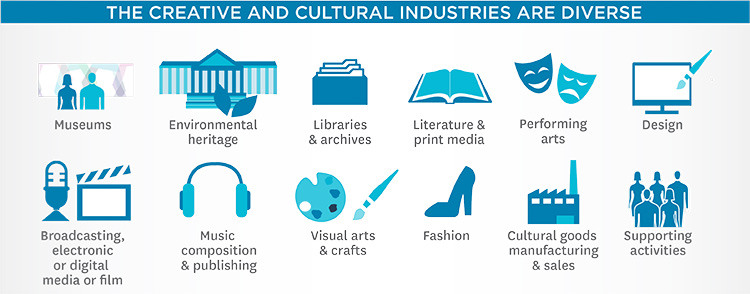
For UNESCO (the United Nations Educational, Scientific and Cultural Organization headquartered in Paris),”The UK is widely recognised as having played a groundbreaking role in developing these analytical models” of the creative industries since 1998.
The Department for Culture, Media and Sport (DCMS) of the United Kingdom Government defined in 2001 the creative industries as follows: “Those industries which have their origin in individual creativity, skill and talent and which have a potential for wealth and job creation through the generation and exploitation of intellectual property.” The United Kingdom Prime Minister’s Strategy Unit and GLA Economics (the Greater London Authority’s economic research unit), among others, have concluded that the creative industries are now even more important than financial services to the London economy!
According to UNESCO‘s “Understanding Creative Industries”:
“The term cultural industries refers to industries which combine the creation, production and commercialization of creative contents which are intangible and cultural in nature. The contents are typically protected by copyright and they can take the form of a good or a service. Cultural industries generally include printing, publishing and multimedia, audiovisual, phonographic and cinematographic productions as well as crafts and design.”
“The term creative industries encompasses a broader range of activities which include the cultural industries plus all cultural or artistic production, whether live or produced as an individual unit. The creative industries are those in which the product or service contains a substantial element of artistic or creative endeavour and include activities such as architecture and advertising.”
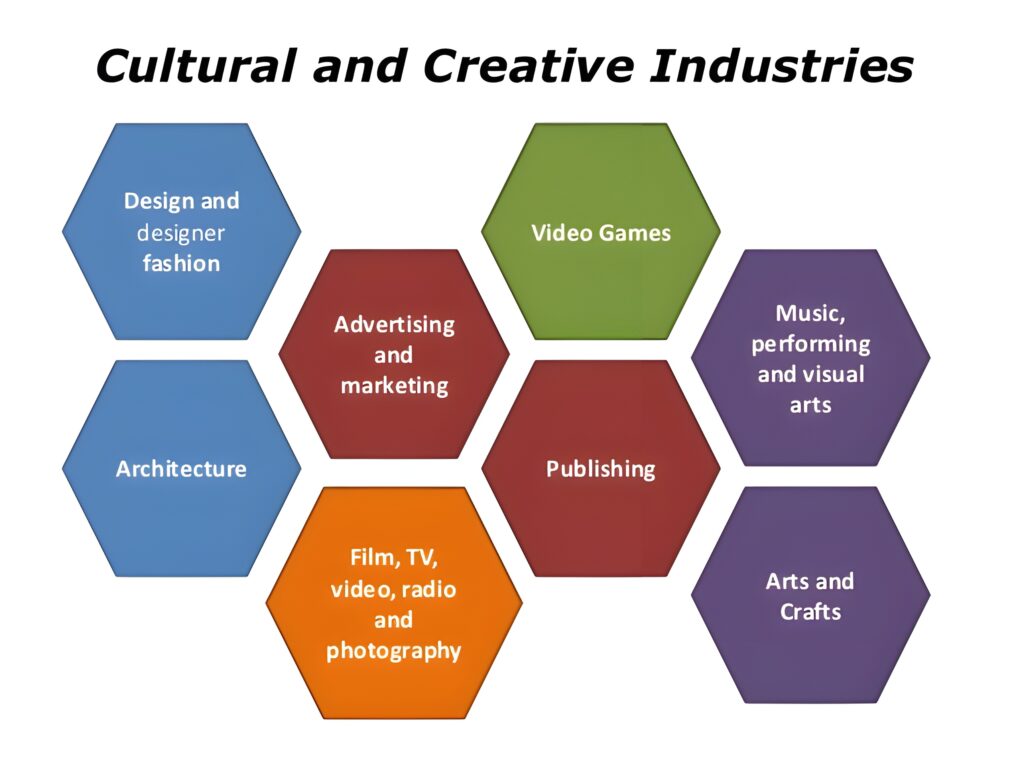
As of 2015, the UK makes a clear difference between the Creative Economy and the Creative Industries (the latter is defined as a subset of the former) and recognizes officially nine sectors being part of the Creative Industries:
- Advertising and marketing
- Architecture
- Crafts
- Design: product, graphic and fashion design
- Film, TV, video, radio and photography
- IT, software and computer services
- Publishing
- Museums, galleries and libraries
- Music, performing and visual arts
For more information about the definition of the CCIs on wikipedia, from an academic point of view:
- The concept of “culture industry” (“kulturindustrie”) was first coined in 1944 by the German sociologists and critical theorists from the Frankfurt School Theodor Adorno and Mark Horkheimer in their critical book towards the cultural industry “Dialectic of Enlightenment“.
For more information about the definition of the CCIs on wikipedia, from a business point of view:
3/6 – The Economy of the Cultural and Creative Industries
According to the official study conducted for the first time in Europe’s history by EY (ex-Ernst & Young) and published in December 2014, “Creating Growth: Measuring cultural and creative markets in the EU“, the Cultural and Creative Industries represent in Europe:
- € 535.9 billion in turnover i.e. 4.2% of Europe’s GDP – € 74.6 billion only in France
- 7.1 million jobs i.e. 3.3% of the EU’s working population (third-largest employer, employ over 5 times as many Europeans as the telecommunications industry) – 1.2 million jobs only in France
They include (> 2012 turnover in the EU):
- Visual Arts (Design, Fashion*, Photography, Museums,…) > € 127.6 billion
- Publishing* (Books, Newspapers, Magazines,…) > € 107.1 billion
- Advertising* > € 93 billion
- Television* > € 90 billion
- Architecture > € 36.2 billion
- Performing Arts (Concerts*, Festivals,…) > € 31.9 billion
- Music* > € 25.3 billion
- Film > € 17.3 billion
- Video Games (computer games, phone and online gaming,…) > € 16 billion
- Radio* > € 10.4 billion
Also included in the CCIs sometimes:
- Libraries, Electronic Publishing and Softwares*
- Education*, Research and Development
- Cultural Tourism* and Gastronomy
- Sports and Outdoor Activities
*At one point in my life, I have worked in these 10 sectors of the cultural and creative industries.
Additional resources about the cultural and creative industries:
- The United Kingdom Creative Economy and Creative Industries, the foundational DCMS Creative Industries Mapping Documents (of April 1998 and April 2001) and the DCMS Creative Industries Economic Estimates (January 2015)
- In the 2010 Cultural and Creative Economy series of the British Council, “Mapping the Creative Industries: A Tool Kit”
- On the OECD’s website, “Key role of cultural and creative industries in the economy” written by a director of UNESCO
- The European Union Commission, “Supporting cultural and creative industries”
- The 2014 ECBN’s manifesto for internationalisation: “ACCESS: A Manifesto for Growth in Europe’s Cultural and Creative Industries” and the 2015 ECBN’s manifesto: “The Cultural and Creative Industries in Europe” by the European Creative Business Network
For more information about the European and Global Ernst & Young studies realized in 2014 and then in 2015:
- The executive summary of the 2014 study on EY’s website commissioned by GESAC (European Grouping of Societies of Authors).
- The 2014 complete study in French “Les secteurs culturels et créatifs européens, générateurs de croissance” and in English “Creating Growth: Measuring cultural and creative markets in the EU” on EY’s website commissioned by GESAC.
- The executive summary of the 2015 study commissioned by CISAC (the International Confederation of Societies of Authors and Composers) and UNESCO.
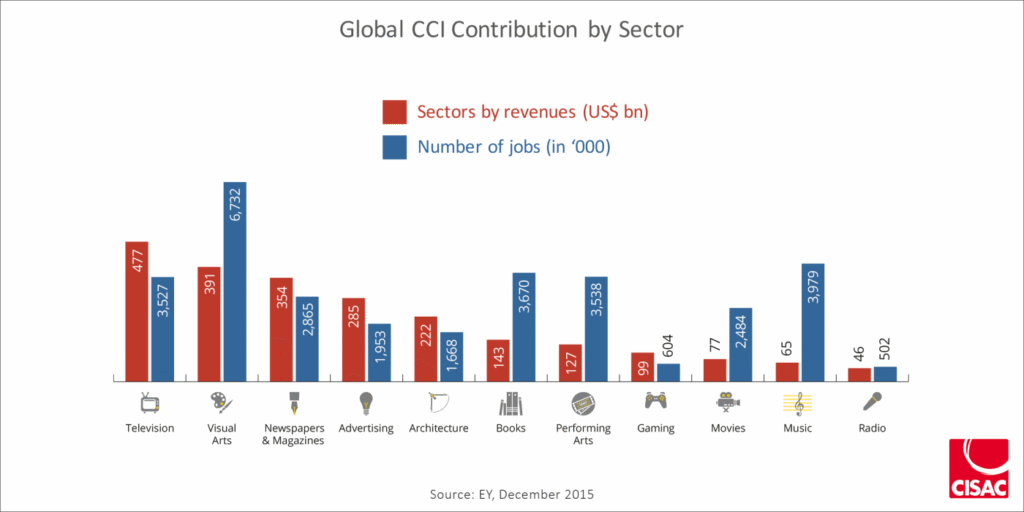
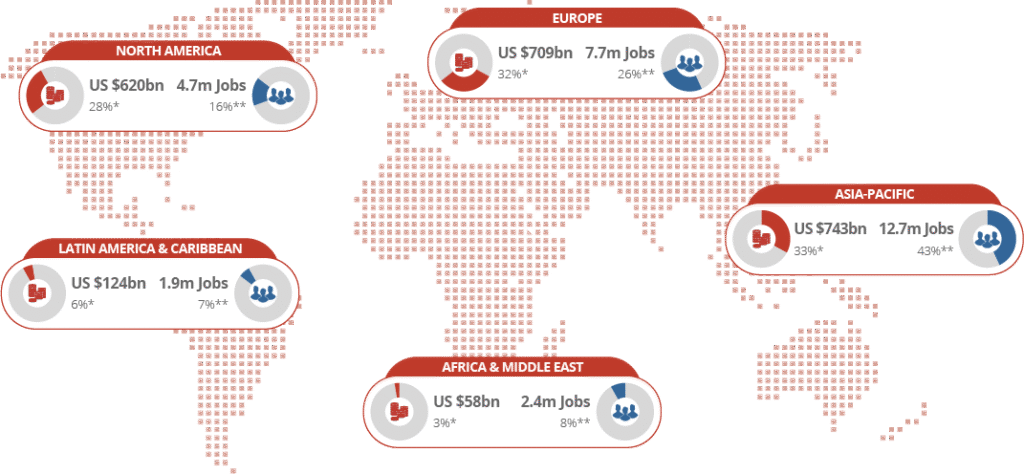
- The complete results of the 2015 study “Cultural Times:The First Global Map of Cultural and Creative Industries” used to be available on EY’s website, UNESCO’s website or on the dedicated website of CISAC presenting the study, World Creative. For the first time, this survey quantified the global economic and social contribution of this important sector. The study analyzed 11 CCIs: advertising, architecture, books, gaming, movies, music, newspapers/magazines, performing arts, radio, television and visual arts.
4/6 – The French Cultural and Creative Industries
EY was the first to publish a comprehensive economic study on the Cultural and Creative Industries in France in November 2013 in French “1er panorama des industries culturelles et créatives en France. Au coeur du rayonnement et de la compétitivité de la France” and in English “First overview of Cultural and Creative Industries. At the heart of France’s Influence and Competitiveness” in partnership with the main professional associations and societies of Culture and Creation in France under the patronage of the French Government and then again in October 2015 “Création sous tension – 2e panorama de l’économie de la culture et de la création en France”.
On the EY’s website dedicated to the French CCIs, France Creative, we could find a short executive summary in English on the French Cultural and Creative Industries stating that “One of France’s centres of excellence, the cultural and creative industries account for 4% of GDP, which puts France second among the G8 countries just behind the USA. Their development stands for critical soft power with high geostrategic stakes. The new forms of creation and distributions of their goods and services give the French cultural industries important leverage for growth.” and that “France has the largest music publishing company in the world (Universal Music Group), one of the international leaders in web-based music streaming services (Deezer), the second largest publishing group on the worldwide scene (Hachette), and the third video game publisher (Ubisoft). France ranks third in the world as cinema producer and second only to the US as exporter; is the third international editor of animation films. The country has the first European TV broadcaster (TF1), the second most broadcasted musical repertoire in the world just after the Anglo-American repertoire.”
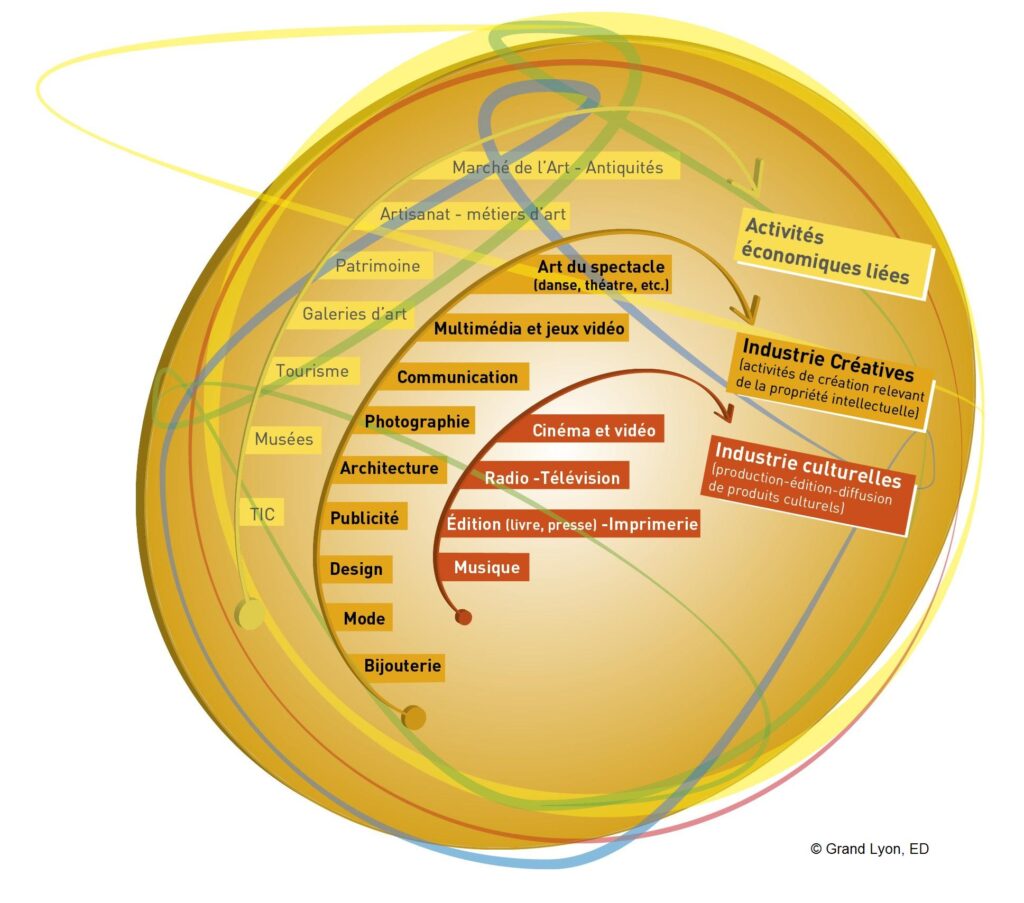
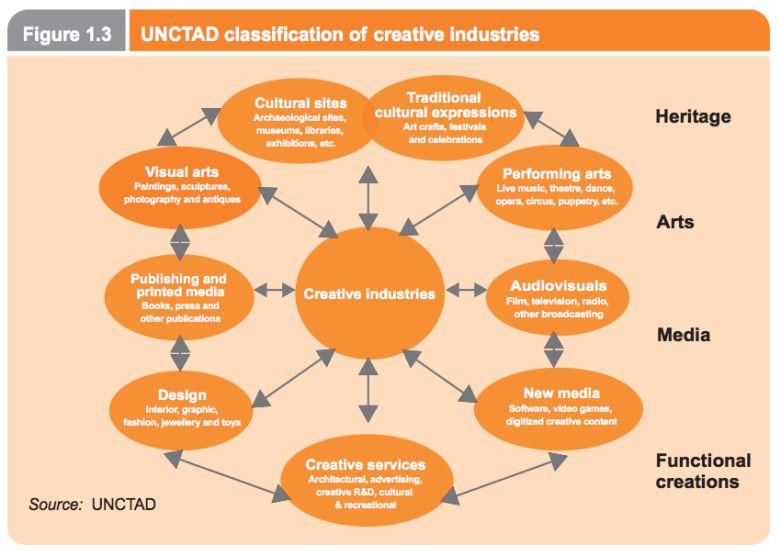
Source: Summary diagram of a possible classification of the creative industries sector, Grand Lyon, June 2013 (Industries créatives, Wikipedia)
The European Cultural and Creative Industries Alliance, ECCIA, is composed of the five national European luxury good organizations – Circulo Fortuny (Spain), Fondazione Altagamma (Italy), Meisterkreis (Germany), Walpole (United Kingdom) and of course, the prestigious Comité Colbert for France with members such as:
- Haute Couture and Fashion brands – Lanvin (1889), Chanel (1912), Lacoste (1933), Pierre Balmain (1945), Céline (1945), Christian Dior Couture (1947), Chloé (1952), Givenchy (1952), Yves Saint Laurent (1962)…
- Leather Goods brands – Hermès (1837), Berluti (1895), Louis Vuitton (1854), Longchamp (1948)…
- Fragrance and Cosmetic brands – Guerlain (1828), Caron (1904), Parfums Chanel (1924), Rochas (1925), Lancôme/L’Oréal Produits de Luxe (1935), Parfums Christian Dior (1948), Parfums Hermès (1948), Parfums Givenchy (1957), Yves Saint Laurent Parfums (1962)…
- Jewelry and Crystal brands – Baccarat (1764), Breguet (1775), Cartier (1847), Boucheron (1858), Van Cleef & Arpels (1906)…
- Wine and Spirits brands – Château d’Yquem (1593), Veuve Clicquot Ponsardin (1772), Champagne Bollinger (1829), Château Cheval Blanc (1832), Champagne Krug (1843), Château Lafite-Rothschild (1855)…
- Gastronomy brands – Dalloyau (1682), Hédiard (1854), Lenôtre (1957), La Maison du Chocolat (1977), Pierre Hermé (1996), Alain Ducasse au Plaza Athénée (2000), L’Atelier de Joël Robuchon Étoile (2010)…
- Hospitality brands – Le Meurice (1835), Le Ritz (1898), Le Plaza Athénée (1911), Le Bristol (1924), Le George V (1928)…
- Cultural institutions – La Sorbonne (1257), Château de Versailles (1661), Villa Médicis (1666), Opéra National de Paris (1669), Comédie Française (1680), Musée du Louvre (1793), Les Arts Décoratifs (1882), IRCAM (1976), Musée d’Orsay (1986)…
5/6 – The Theory and Scholars of the Cultural and Creative Industries
“Experience without theory is blind, but theory without experience is mere intellectual play.“
Immanuel Kant
The contributions of the academics and alumni of both the University of Paris I Panthéon-Sorbonne (Paris 1) and the London School of Economics and Political Science (LSE) to the transdisciplinary field of the cultural and creative industries (including the economics of the arts and literature, cultural economics, media economics, media sociology, media law and media management) have been foundational, essential and paramount since the 1970’s.
I have had a passion for media and entertainment (comic books, music, radio, cinema, television and video games) since childhood. That is why it was my teenage dream to study at Paris 1 and LSE…
“You cannot open a book without learning something.”
Confucius
“It’s been my experience in life, if you just keep thinking and reading, you don’t have to work.”
“In my whole life, I have known no wise people (over a broad subject matter area) who didn’t read all the time – none, zero.”
Charlie Munger
Here is the list of the most influential scholars of the cultural and creative industries (my very personal and informal literature review):
- Media studies and the academic field of the cultural and creative industries have drawn heavily on the earlier works, theories and ideas developed by these renowned scholars in the social sciences and humanities (and more specifically from philosophy, literary, semiotics, semiology, psychology, sociology, anthropology, ethnology, political science and political economy): Claude-Henri de Rouvroy, Compte de Saint-Simon, Auguste Comte, Karl Marx, Gabriel Tarde, Gustave Le Bon, Ferdinand de Saussure, Emile Durkheim, Max Weber, Jacques Lacan, Jean-Paul Sartre, Simone de Beauvoir, Hannah Arendt, Claude Lévi-Strauss, Aimé Césaire, Roland Barthes, Edgar Morin, Gilles Deleuze, Michel de Certeau, Frantz Fanon, Michel Foucault, Jürgen Habermas, Jean Baudrillard, Jacques Derrida, Pierre Bourdieu, Michel Serres, Guy Debord, Umberto Eco, Edward Said and Régis Debray.
- Harold Lasswell, American political scientist and communication theorist who was a pioneer of media studies considered to be one of the fathers of the field with Paul Lazarsfeld, Harold Innis and Marshall McLuhan. He is the author of “Propaganda and Promotional Activities: An Annotated Bibliography” (1935), “World Revolutionary Propaganda: A Chicago Study” (1939) and “Propaganda, Communication, and Public Opinion: A Comprehensive Reference Guide” (1946).
- Paul Lazarsfeld, Austrian-American sociologist and mathematician and author of “Radio and the printed page. An introduction to the study of radio and its role in the communication of ideas” (with Frank Stanton,1940) and “Personal Influence: The Part Played by People in the Flow of Mass Communications” (with Elihu Katz, 1955).
- The critical study of the cultural and creative industries has its origins in the book Dialectic of Enlightenment (German: Dialektik der Aufklärung) written by the Frankfurt School philosophers Max Horkheimer and Theodor W. Adorno (1947) where they coined the important concept of the culture industry.
- Harold Innis (University of Toronto), Canadian Professor of Political Economy, founder of the Toronto school of communication theory with Eric A. Havelock and author of “Empire and Communications” (1950) and “The Bias of Communication” (1951).
- Marshall McLuhan (University of Toronto), Canadian Professor of English and author of pioneering books in popular culture, cultural studies, communication theory and media ecology: “The Mechanical Bride: Folklore of Industrial Man” (1951), “The Gutenberg Galaxy: The Making of Typographic Man” (1962) and “Understanding Media: The Extensions of Man” (1964). McLuhan is known for coining the expressions “the medium is the message”, “hot” and “cool” media, the “global village”, and for predicting the World Wide Web almost thirty years before it was invented. McLuhan‘s pioneering work is viewed as one of the cornerstones of media studies.
- Henri Mercillon (Université de Paris I), French Professor Emeritus of Economics and former director of the Centre d’Economie de l’Information de Paris 1 (the Sorbonne Center for the Information Economy), author of “Cinéma et Monopoles. Le Cinéma aux Etats-Unis : Etude Economique” (1952), “Industrie culturelle et littérature économique” (1963), “Economie de l’information” (1966-1967), “Economie des moyens d’information” (1967), “Monopoles de la connaissance et concurrence des moyens d’informations” (in “La Monnaie et l’économie de notre temps: mélanges en l’honneur du professeur Émile James”, 1974), “Le Secteur commercial de la radio-diffusion d’État française : éléments d’une problématique socio-économique” (in “Mélanges offerts à Henri Guitton : le temps en économie, les mathématiques et l’économie, recherches pluridisciplinaires”, 1977), “Les musées: institutions à but non lucratif dans l’économie marchande” (1977), “Le cinéma : entre l’art et l’argent” (by Pierre-Jean Benghozi, préface/foreword by Henri Mercillon, 1989) and editor of “O.R.T.F., l’agonie du monopole? La problématique de la télévision française durant la décennie soixante-dix” (1973) – the minutes of the historical pluridisciplinary symposium on French Television that Henri Mercillon organized at the Sorbonne on October 10, 1972.
- Калистратов, Юрий Александрович (Yuriy Alexandrovich Kalistratov, 1899-1973), Russian Professor of the Economics of Cinema, author of “Вопросы экономики советской кинематографии” (1956) and “Экономика производства и обращения кинофильмов в СССР” (1958). He conducted two pioneer and very important studies on the film industry in the USSR in 1958 and 1960. Since 1935, he was the supervisor of the laboratory of feasibility studies at the famous NIKFI (the Soviet Scientific Research Cinema & Photography Institute). In 1943-1945, he taught at the Moscow branch of the Leningrad Institute of Cinema Engineers/LIKI (now the St. Petersburg State University of Film and Television/GUKIT) and in 1946-1948, at the All-Union State Institute of Cinematography/VGIK (now the All-Russian State University of Cinematography or Всероссийский государственный институт кинематографии имени С. А. Герасимова), the world’s oldest film school. Kalistratov‘s work had a great influence on a few economists outside the USSR, including Henri Mercillon.
- Elihu Katz, American-Israeli sociologist and communication scientist whose expertise was uses and gratifications theory and author of “Personal Influence: The Part Played by People in the Flow of Mass Communication” (with Paul Lazarsfeld, 1955) and “Media Events: The Live Broadcasting of History” (with Daniel Dayan, 1992).
- George Gerbner (UCLA, UC Berkeley and USC alumnus, Dean of the Annenberg School for Communication at the University of Pennsylvania between 1964 and 1989), American Professor of Communication, the founder of cultivation theory and author of “Toward a General Theory of Communication” (1955), “Living with Television: The Violence Profile” with Larry Gross (1976), “Violence and Terror in the Mass Media: An Annotated Bibliography” with Nancy Signorelli (1988), “Triumph of the Image: The Media’s War in the Persian Gulf, A Global Perspective” with Hamid Mowlana and Herbert Schiller (1992), “The Global Media Debate” with Hamid Mowlana and Kaarle Nordenstreng (1993) and “Invisible Crises: What Conglomerate Control of Media Means for America and the World” with Hamid Mowlana and Herbert Schiller (1996).
- Edgar Morin (Université de Paris alumnus), French philosopher and sociologist of the theory of information who has been recognized for his work on complexity and “complex thought” (pensée complexe) and author of “Le Cinéma ou l’homme imaginaire” (1956), “L’esprit du temps. Essai sur la culture de masse” (1962) and “Le Cinéma : Un art de la complexité” (2018).
- Raymond Williams (University of Oxford, University of Cambridge), Welsh Professor of Drama, Culture, Media and Political Science, media critic and author or “Culture and Society” (1958), “Communications” (1962) and “Television: Technology and Cultural form” (1974). Williams extensively wrote about the media (especially about culture, literature, drama, theatre, cinema, radio and most of all television) and is seen as one of the founders of the British field of cultural studies with Richard Hoggart and Stuart Hall.
- Michael Conant (UC Berkeley), American Professor Emeritus of Business, author of “Antitrust in the Motion Picture Industry: Economic and Legal Analysis” (1960). Conant‘s work had a great influence on many lawyers and economists, including Henri Mercillon.
- Jürgen Habermas, German philosopher and social theorist in the tradition of critical theory and pragmatism. Associated with the Frankfurt School, his work addresses communicative rationality and the public sphere. A very influential scholar in the academic field of communication and media studies, Habermas is the author of “The Structural Transformation of the Public Sphere” (1962).
- William Baumol (LSE alumnus, Princeton University, New York University), American Professor Emeritus of Economics, author of “Performing Arts – The Economic Dilemma: A Study of Problems Common to Theater, Opera, Music and Dance” (with William Bowen, 1965). Baumol is widely known all around the world for producing the first seminal work in cultural economics.
- Guy Debord (Université de Paris alumnus but left without a degree), French Marxist theorist, writer, filmmaker and poet, who wrote the worldwide best seller “La société du spectacle” in 1967 which is considered to be a catalyst for the Paris uprising and revolts of May 1968. Debord played an influential role among the left-wing protesters (especially at Nanterre and Sorbonne Universities). His Marxist positions criticizing capitalism including the culture industry, consumerism, commodity fetishism, class alienation, mass media and cultural homogenization, are similar to the ones exposed earlier by the Frankfurt School (especially by Theodor W. Adorno, Max Horkheimer and Herbert Marcuse). Debord‘s work had a very important impact on media culture, media studies, cultural studies, social theory, sociology and philosophy from the 1960s until today.
- Herbert Schiller, American media critic, sociologist, author, and scholar, author of “Mass Communications and American Empire” (1969), “The Ideology of International Communications” (1991) and “Mass Communications and American Empire: Second Edition, Updated (Critical Studies in Communication and in the Cultural Industries)” (1992).
- Pierre Bourdieu, French Professor of Sociology. After Michel Foucault, Pierre Bourdieu is the second most-cited academic author of books in the humanities in the world. He influenced many sociologists, economists, political scientists, anthropologists and philosophers around the world, including Anthony Giddens. From 1960, he was the assistant of Raymond Aron at the Université de Paris and secrétaire of the Centre de Sociologie Européenne (CSE) founded by Raymond Aron in 1959, from 1964 he taught at the EPHE, in 1968 he created the Centre de Sociologie de l’Education et de la Culture (CSEC), from 1975 he taught at the EHESS and from 1981 at the Collège de France. In 1997, the CSE and the CSEC merged together and in 2010 the new CSE merged with the Centre de Recherches Politiques de la Sorbonne (CRPS) founded by Jacques Lagroye (who himself had succeeded the eminent Maurice Duverger as Director of the Sorbonne Department of Political Science in 1981) to become the Centre Européen de Sociologie et de Science Politique de la Sorbonne (CESSP) which therefore became part of the Université de Paris I Panthéon-Sorbonne. Bourdieu is the author of “Le marché des biens symboliques” (1971), “Contribution à une économie des biens symboliques” (1977),”The field of cultural production, or: The economic world reversed” (1983), “L’économie des biens symboliques” (1993-1994), “Sur la télévision“ (1996) his most famous book on media sociology and “The economy of symbolic goods” (1998).
- Armand Mattelart (Pontificia Universidad Católica de Chile from 1962 to 1973, Université Paris VII and Université Paris VIII from 1976 to 1980, Université Rennes II from 1983 to 1997 and Université Paris VIII from 1997 to 2005), Belgian-French sociologist, Professor of Information and Communication Sciences, President of the “Observatoire français des médias” since its creation in 2003, Social Development Expert for the United Nations Development Programme (UNDP) and for the Food and Agriculture Organization of the United Nations (FAO), his work deals with media, culture and communication, specially in their historical and international dimensions. He has been a very influential communication scholar in the academic field of media and globalization around the world and he was one of the main reasons why I decided to study the media and globalization. He is the author of the very famous pamphlet translated in many languages, best seller throughout Latin America and seminal work in cultural studies, “How to Read Donald Duck” (Spanish: “Para leer al Pato Donald“, French: “Donald l’imposteur, ou l’impérialisme raconté aux enfants”, with Ariel Dorfman, 1971), a critique of North American cultural imperialism, “Mass Media, idéologies et mouvement révolutionnaire (Chili 1970-1973)” (1974), “Multinationales et système de communication” (1976), “Télévision: enjeux sans frontières” (1980), “L’Ordinateur et le tiers-monde” (1983), “La Culture contre la démocratie ? L’audiovisuel à l’heure transnationale” with Michèle Mattelart and Xavier Delcourt (1984), “Penser les médias” with Michèle Mattelart (1986), “L’internationale publicitaire” (1989), “La publicité” (1990), “La Communication-monde” (1992), “L’invention de la communication” (1994), “Histoire des théories de la communication” with Michèle Mattelart (1995), “La mondialisation de la communication” (1996), “Histoire de l’utopie planétaire. De la cité prophétique à la société globale” (1999), “Histoire de la société de l’information” (2001), “Introduction aux Cultural Studies” with Érik Neveu (2003), “Diversité culturelle et mondialisation” (2005), “La globalisation de la surveillance” (2007), “Pour un regard-monde. Entretiens avec Michel Sénécal” (2010), and finally, “Le profilage des populations : Du livret ouvrier au cybercontrôle” with André Vitalis (2014).
- Alan T. Peacock (former LSE), British Composer and Professor of Economics, author of “The Composer in the market place” (with Ronald Weir, 1975), “Cultural Economics and Cultural Policies” (with Ilde Rizzo, 1994) and “The Heritage Game: Economics, Policy, and Practice” (with Ilde Rizzo, 2008). During the 1970s and 1980s, Peacock played a leading role in the field of cultural economics.
- Henri Bartoli (co-founder of the Université de Paris I), French Professor Emeritus of Economics, a specialist of political economy, the history of economic thought, especially in France and in Italy, labor economics, structuralist economics and economic systems, author of “Economie et création collective” (1977), a UNESCO contributor and researcher on (1) social economics and ethics, (2) development economics, globalization and poverty, and (3) Europe and culture. He was the international vice-president (1992-2003) of the Société Européenne de Culture/European Society of Culture created in Venice in 1950 (that built bridges between Western Europe and Eastern Europe during the Cold War, maintaining intellectual dialogue between East and West). Bartoli encouraged a new generation of young and brilliant PhD students at the University of Paris 1 Panthéon-Sorbonne to conduct research in the field of cultural economics and economics of the arts, literature and media in the 1970s and 1980s, often acting as their doctoral advisor and supervising their thesis at Paris 1.
- Bernard Miège (Université de Paris alumnus, Université de Grenoble III), French Professor Emeritus of Information and Communication Sciences, author of “Un agent de l’offre de biens et services de loisir : L’entreprise et son comité d’entreprise” (his 1968 doctoral thesis at the University of Paris supervised by Henri Bartoli), “Capitalisme et industries culturelles” (with Armel Huet, Jacques Ion, Alain Lefèbvre and René Peron, 1978), “Recherches sur la production culturelle marchande et non-marchande : note de présentation de travaux” (1979 doctoral thesis), “The logics at work in the new cultural industries” (1987), “The Capitalization of Cultural Production” (1989), the article “L’Economie politique de la communication” (2004) and the article “Media and Cultural Industries: a Socioeconomic Approach” (2008). A disciple of Henri Bartoli, Miège is widely seen globally as the founder of the socio-economic study of the culture and communication industries. In 1978, he co-founded the famous research laboratory GRESEC (Groupe de Recherche sur les Enjeux de la Communication) at the University of Grenoble 3. Bernard Miège influenced other important culture and media academics such as Nicholas Garnham, Philippe Bouquillion and David Hesmondhalgh, as well as the UK government for their own use and definition of the concept of “Cultural Industries” (Pratt, 2008).
- René Bonnell (Université de Paris I alumnus), senior executive of the French film industry (Gaumont, Canal+, France Télévisions), film distributor, producer and author of “L’Initiative culturelle en économie de marché: l’exemple du cinéma français depuis 1945” (1976 doctoral thesis at Paris 1), “Le cinéma exploité” (his 1978 book based on his doctoral thesis, préface/foreword by Henri Bartoli) and “Le financement de la production et de la distribution cinématographiques à l’heure du numérique” (2013). Since Henri Mercillon’s doctoral thesis in 1952, René Bonnell‘s 1976 thesis under the supervision of Henri Bartoli is considered the greatest study ever done and the best work ever written in France on the economics of cinema.
- Dominique Leroy (Université de Paris I), French Professor Emeritus of Economics, author of “Economie des arts du spectacle vivant : Essai sur la relation entre l’économique et l’esthétique” (1977 doctoral thesis at Paris 1, published as a book with a préface/foreword by Henri Bartoli in 1980), “Histoire des arts du spectacle en France: aspects économiques, politiques et esthétiques de la Renaissance à la Première Guerre mondiale” (1990) and “Hommage à Henri Bartoli” (2011). Dominique Leroy was the chosen successor of Henri Bartoli at the head of the European Society of Culture’s French Center (Société Européenne de Culture).
- John Fiske, British media scholar and cultural theorist, a student of Raymond Williams, he played a very important role in cultural studies, the critical analysis of popular culture, media semiotics, and television studies. He is the author of “Reading Television” with John Hartley (1978), the very influential “Television Culture” (1987), “Understanding Popular Culture” (1989) and “Reading the Popular” (1989).
- Nadine Toussaint-Desmoulins (Université de Paris alumna, Université de Paris II), French Professor Emerita of Media Economics, author of “L’économie des médias” (1978). This book is considered the first textbook on media economics ever written in the world of global academia.
- Nicholas Garnham (Université de Paris alumnus, University of Westminster), British Emeritus Professor of Media Studies, author of “Contribution to a Political Economy of Mass Communication” (1979), “The Economics of Television: the UK case” (with Richard Collins and Gareth Locksley, 1988), “Capitalism and Communication: Global Culture and the Economics of Information” (1990), “From the arts to the creative industries: anatomy of a confusion” (2001) and of the article “From Cultural to Creative Industries: An analysis of the implications of the “creative industries” approach to arts and media policy making in the United Kingdom” (2005). A very influential scholar of Media Studies, Garnham was the founding editor of the prestigious journal “Media, Culture and Society” since 1979.
- David Throsby (LSE alumnus, Macquarie University), Australian Distinguished Professor of Cultural Economics, author of “The Economics of the Performing Arts” (with Glenn Withers, 1979), “The Production and Consumption of the Arts: A View of Cultural Economics” (1994), “Economics and Culture” (2001) and “The Economics of Cultural Policy” (2010).
- Régis Debray (Université de Paris I alumnus), French philosopher, journalist, former government official and academic known for his theorization of mediology, a critical theory of the long-term transmission of cultural meaning in human society, and author of “Le pouvoir intellectuel en France” (1979), “Vie et mort de l’image : une histoire du regard en Occident” (1992), “L’État séducteur: les révolutions médiologiques du pouvoir” (1993), “Manifestes médiologiques” (1994), “Transmitting Culture” (2004) and “Civilisation. Comment nous sommes devenus américains” (2017).
- Dominique Wolton (CNRS), French sociologist who popularized media sociology in the French media and author of “L’information demain. De la presse écrite aux nouveaux médias” avec Jean-Louis Lepigeon (1979), “Le spectateur engagé” with Raymond Aron and Jean-Louis Missika (1981), “Terrorisme à la une. Média, terrorisme et démocratie” avec Michel Wieviorka (1987), “Éloge du grand public. Une théorie critique de la télévision” (1990), “Penser la communication” (1997) and “Internet et après ? Une théorie critique des nouveaux médias” (1999).
- Francis Balle (Université de Paris II), French academic teacher and researcher. He is also a philosopher, a professor of political science and author of Médias et Sociétés (1980), “Et si la presse n’existait pas” (1987), “Le Mandarin et le marchand : le juste pouvoir des médias” (1995), “Les nouveaux médias” with Gérard Eymery (1996), Dictionnaire des médias (1998), Les médias (2000), “La convergence de l’audiovisuel, de l’informatique et des télécommunications : mythes et réalités” (2000) and “Dictionnaire du web” with Laurent Cohen-Tanugi (2001).
- Michael Palmer (Université de Paris III), Franco-English Professor of Information and Communication Sciences at the University of Paris III – Sorbonne Nouvelle and author of “Le Trafic de nouvelles” with Oliver Boyd-Barrett (1980) and “Arts du spectacle, métiers et industries culturelles: Penser la généalogie” with Laurent Creton and Jean-Pierre Sarrazac (2005).
- Patrice Flichy (Université de Paris I alumnus, formerly Stanford University, Université Paris-Est), French Professor of Sociology, author of “Les industries de l’imaginaire. Pour une analyse économique des médias” (1980), “L’imaginaire d’Internet” (2001) and “Le sacre de l’amateur. Sociologie des passions ordinaires à l’ère numérique” (2010).
- Jean Baudrillard (Université de Paris alumnus), French sociologist, philosopher, cultural theorist, political commentator and photographer, frequently associated with postmodernism and specifically post-structuralism, is one of the most emblematic writers of the French Theory that influenced many American and British academics from departments of Humanities and Social Sciences in US and UK universities in the 1970s and 1980s which led to the creation of Cultural Studies, Postcolonial Studies and Gender Studies. Baudrillard is the author of the very influential book in the fields of Social Sciences and Humanities “Simulacres et Simulation” (1981).
- Xavier Greffe (Université de Paris I), French Professor Emeritus of Cultural Economics and Economics of the arts, literature and culture, author of the influential “Analyse économique de la bureaucratie” (1981), “Socio-économie de la culture. Livre, Musique” (with François Rouet and Sylvie Pflieger, 1990) and “La politique culturelle en France” (with Sylvie Pflieger, 2015). Along with Henri Bartoli and Henri Mercillon, Xavier Greffe has been one of the most influential professors and researchers in the field of the economics of the cultural and creative industries in France and has trained several generations of students at the University of Paris 1 Panthéon-Sorbonne in cultural economics, economics of the arts and media economics.
- Roger Silverstone (LSE), British sociologist and media scholar, he was the first Professor of Media and Communications at LSE in 1998, Founder and inaugural Head of the Department of Media and Communications at the LSE (founded in 2003), author of “The Message of Television: Myth and Narrative in Contemporary Culture” (1981), “Television And Everyday Life” (1994), “Why study the media?” (1999) and “Media and Morality: On the Rise of the Mediapolis” (2006). Roger Silverstone is one of the main reasons why I decided to study at the London School of Economics. Unfortunately, he died in July 2006, just before I started my MSc in Global Media and Communications at LSE in 2007.
- Daniel Dayan (Université de Paris alumus), French social scientist and media sociologist, his work is characterized by an emphasis on visual forms in the mass media. It covers three interrelated areas: the aesthetics of cinema, the anthropology of television, and the sociology of media and publics. Dayan is the author of “Western Graffiti : Jeu de l’image et Programmation du Spectateur dans un film de John Ford” (1983), “Media Events. The Live Broadcasting of History” (with Elihu Katz, 1992) and “La terreur spectacle: Terrorisme et télévision” (2006).
- Alain Herscovici (Université de Paris I alumnus, Universidade Federal do Espírito Santo), French Professor of Cultural Economics, author of “Essai sur l’économie de la musique moderne” (1983 doctoral thesis at Paris 1 supervised by Henri Bartoli) and “Economie de la culture et de la communication: Elements pour une analyse socio-economique de la culture dans le capitalisme avancé” (1994).
- Alain Busson (Université de Paris I alumnus, HEC Paris), French Professor Emeritus of Media Economics and Economy of the Cultural and Creative Industries, author of “La place du théâtre dans le champ culturel. De l’influence de l’économique sur les choix esthétiques” (1983 doctoral thesis at Paris 1 supervised by Henri Bartoli and with Henri Mercillon and Xavier Greffe as members of the jury), “Le théâtre en France” (1986), “Portraits économiques de la culture” (with Yves Evrad, 1987), “Le management des entreprises artistiques et culturelles” (with Y. Evrard, C. Cauvin, E. Chiapello, N. Ferry-Maccario, A. Hadida, A. Keravel, O. Silhol, 1993), “Les industries culturelles et créatives – Economie et stratégie” (with Yves Evrard, 2013) and editor of “Management des industries culturelles et créatives” (with Yves Evrard, 2015).
- Pierre-Michel Menger (Collège de France), French Professor of Sociology, author of “Le Paradoxe du musicien : le compositeur, le mélomane et l’État dans la société contemporaine” (1983), “Portrait de l’artiste en travailleur. Métamorphoses du capitalisme” (2003), “Le travail créateur. S’accomplir dans l’incertain” (2009) and “The Economics of Creativity. Art and Achievement Under Uncertainty” (2014).
- Alain Le Diberder (Université de Paris I alumnus), French senior executive of the television industry (France Télévisions, Canal+, AlloCiné, Arte), author of “La production des réseaux de télécommunication : examen critique de la solution française” (1980 doctoral thesis at Paris 1 supervised by Pierre Bauchet), “La formation du profit dans les industries culturelles” (1985), “La Télévision” (with Nathalie Coste-Cerdan, 1986), “Révolution numérique et industries culturelles” (with Philippe Chantepie, 2005 & 2010) / “Économie des industries culturelles” (with Philippe Chantepie, 2019).
- Dominique Sagot-Duvauroux (Université de Paris I alumnus, Université d’Angers), French Professor of Cultural Economics, author of “Structure de financement et organisation d’un système, l’exemple du théâtre” (1985 doctoral thesis at Paris 1 supervised by Xavier Greffe), “Le Marché de l’art contemporain en France, prix et stratégies” (with Bernard Rouget and Sylvie Pflieger, 1991) and “Le Marché de l’art contemporain” (with Nathalie Moureau, 2006).
- Françoise Benhamou (Université de Paris I alumna), French Professor of Cultural Economics, author of “Essai d’analyse économique d’une pratique culturelle: la lecture et l’achat et de livres” (1985 doctoral thesis at Paris 1 supervised by Xavier Greffe), “L’économie de la culture” (1996), “Les galeries d’art contemporain en France. Portrait et enjeux face à la mondialisation” (with Dominique Sagot-Duvauroux and Nathalie Moureau, 2001), “L’économie du star system” (2002), “Les dérèglements de l’exception culturelle : Plaidoyer pour une perspective européenne” (2006), “Droit d’auteur et copyright” (with Joëlle Farchy, 2007), “Économie du patrimoine culturel” (2012),”Le Livre à l’heure numérique : papier, écrans, vers un nouveau vagabondage” (2014) and “Politique culturelle : fin de partie ou nouvelle saison ?” (2015).
- Wladimir Andreff (Université de Paris I), French Professor Emeritus of Economics, author of “Economie du sport” (1986), “Handbook on the Economics of Sport” (editor with Stefan Szymanski, 2009), “Economie internationale du sport” (2010) and “Mondialisation économique du sport. Manuel de référence en économie du sport” (2012). Andreff was President of the French Economic Association (Association Française de Science Economique/AFSE), of the International Association of Sport Economists/IASE and of the European Association for Comparative Economic Studies/EACES.
- Enrique Bustamente Ramírez (Universidad Complutense de Madrid), Spanish Professor of Information and Communication Sciences, author of “Las industrias culturales en España” (1986) and editor of “Industrias creativas. Amenazas sobre la cultura digital” (2011).
- Noam Chomsky, American professor and public intellectual known for his work in linguistics, political activism, and social criticism. He is the author of “Manufacturing Consent: The Political Economy of the Mass Media” (with Edward S. Herman, 1988).
- Joelle Farchy (Université de Paris I), French Professor of Cultural Economics and Information and Communication Sciences, author of “Le cinéma français sous influence: de la concurrence audiovisuelle à la différentiation des produits cinématographiques” (1989 doctoral thesis at Paris 1 supervised by Bernard Gazier), “Le cinéma déchaîné. Mutation d’une industrie” (1992), “Économie des politiques culturelles” (with Dominique Sagot-Duvauroux, 1994), “Internet et le droit d’auteur, la culture Napster” (2003), “L’industrie du cinéma” (2004), “Les enjeux de la mondialisation culturelle” (with Jean Tardif, 2006) and “Droit d’auteur et copyright” (with Françoise Benhamou, 2007).
- James W. Carey, American communication theorist, media critic, and a journalism instructor credited with developing the ritual view of communication and author of “Communication As Culture: Essays on Media and Society” (1989).
- Robert G. Picard (University of Oxford, Harvard University, Yale University), American academic expert on Media Economics, Media Management and Media Regulation, author of “Media Economics: Concepts and Issues” (1989).
- Bruno Frey (University of Basel), Swiss Professor of Economics and Political Economy, author of “Muses and Markets. Explorations in the Economics of the Arts” (with Walter Pommerehne, 1989).
- Gaëtan Tremblay (UQAM), Canadian Professor of Information and Communication Sciences, who published “Les Industries de la culture et de la communication au Québec et au Canada” (editor, 1990).
- Mario d’Angelo (formerly Université de Paris IV), French Professor of Creative Industries and Strategy, Music Business, Culture and Management, author of “La Renaissance du disque. Les mutations mondiales d’une industrie culturelle” (1990) and “Socio-économie de la musique en France. Diagnostic d’un système vunérable” (1997).
- Pierre Kopp (Université de Paris I), French Professor of Law and Economics, author of “Télévisions en concurrence” (1990).
- Henry Jenkins (University of Southern California), American Provost Professor of Communication, Journalism and Cinematic Arts at USC, author of “Textual Poachers: Television Fans & Participatory Culture” (1992), “Convergence Culture: Where Old and New Media Collide” (2006) and “Spreadable Media: Creating Value and Meaning in a Networked Culture” (with Sam Ford and Joshua Green, 2013). Jenkins is widely regarded worldwide as the founder of fan studies with his seminal and foundational work on fan culture as early as 1992. Henry Jenkins is probably the media scholar who has inspired me the most in my life.
- Philippe Bouquillion* (Université de Paris XIII and Université de Paris VIII), French Professor of Information and Communication Sciences, who published the article “Le spectacle vivant : de l’économie administrée à la marchandisation” (1992), the article “Livre et musique enregistrée sur Internet : quelques enjeux empiriques et théoriques” (2001), the article “The formation of Cultural and Communication Industry Poles : between financial coups and the integration of industrial production lines” (2005), “Les industries de la culture et de la communication en mutation” (editor with Combès, 2007), the article “Les industries de la culture face aux industries de la communication : l’actualité des théories des industries culturelles” (2008), “Les industries de la culture et de la communication. Les stratégies du capitalisme” (2008), “Le Web collaboratif. Mutations des industries culturelles” (with Jacob Matthews, 2010), “Diversité et Industries culturelles” (editor with Combès, 2011), “Creative Economy, Creative Industries : des notions à traduire” (editor, 2012) and the article “Francophone Perspectives on Creative Industries and the Creative Economy” (2014). Philippe Bouquillion is an eminent researcher at the famous LabSIC (Laboratoire des Sciences de l’Information et de la Communication), Research Center for Information and Communication Sciences of the University of Paris 13.
*I consider Bouquillion as the intellectual successor of the most eminent French scholar of the cultural and creative industries, Bernard Miège.
- Ruth Towse (LSE alumna, former LSE, Bournemouth University, Erasmus University Rotterdam), British Professor Emerita of Economics of Creative Industries, Cultural Economics and Economics of Copyright, author of “Singers in the Marketplace: The Economics of the Singing Profession” (with Claus Moser, 1993), “A Handbook of Cultural Economics” (2003), “The Internet and the Mass Media” (with Lucy Küng and Robert G. Picard, 2008), “A Textbook of Cultural Economics” (2010), “Handbook on the Digital Creative Economy” (2013), “Advanced Introduction to Cultural Economics” (2014).
- Scott Lash (LSE alumnus, Goldsmiths), American Professor of Sociology and Cultural Studies, author of “Economies of Signs and Space” (with John Urry, 1994) and “Global Culture Industry: The Mediation of Things” (with Celia Lury, 2007).
- Laurent Creton (Université de Paris III), French Professor of Information and Communication Sciences, author of “Économie du cinéma. Perspectives stratégiques” (1994), “Cinéma et marché” (1997) and “L’économie du cinéma” (2003).
- Manuel Castells (Universitat de Barcelona and Université de Paris alumnus, formerly EPHE between 1965 and 1967, formerly the youngest professor at the Université de Paris – Nanterre Campus between 1967 and 1969 where he taught Daniel Cohn-Bendit, EHESS between 1970 and 1979, Universidad Autonoma de Madrid between 1988 and 1993, University of California, Berkeley between 1979 and 2003, MIT between 2004 and 2009, Oxford, Cambridge and at Universitat Oberta de Catalunya since 2001 and at USC – the University of Southern California since 2003), Spanish sociologist and one of the most influential scholars in the world. He is a scholar of the information society, communication and globalization. The 2000–2014 research survey of the Social Sciences Citation Index ranks him as the world’s fifth most-cited social science scholar, and the foremost-cited communication scholar. He is famous for his trilogy entitled The Information Age: Economy, Society and Culture: “The Rise of the Network Society” (1996), “The Power of Identity” (1997), and” End of Millennium” (1998). He is also the author of “The Internet Galaxy: Reflections on the Internet, Business, and Society“ (2001).
- Vincent Mosco (Harvard University alumnus, Queen’s University, Fudan University), Canadian Professor Emeritus of Sociology at Queen’s University where he was Canada Research Chair in Communication and Society and head of the Department of Sociology and Distinguished Professor at the New Media Centre, Fudan University School of Journalism and Communication, in Shanghai, China. Sociologist, political economist and renowned scholar in critical communication studies, he is the author of the very important book “The Political Economy of Communication” (1996) and “The Digital Sublime: Myth, Power, and Cyberspace” (2004).
- Nathalie Sonnac (Université de Paris I alumna, Université de Paris II), French Professor of Information and Communication Sciences, author of “L’économie de la presse” (with Patrick Le Floch, 2000) and “L’industrie des médias” (with Jean Gabszewicz, 2006).
- Richard Caves (Harvard University), American Professor Emeritus of Economics, author of “Creative Industries: Contracts Between Art & Commerce” (2000).
- Fabrice Rochelandet (Université de Paris I alumnus, Université de Paris III), French Professor of Cultural Economics, Digital Media Economics and Regulation of the Digital Economy author of “Propriété intellectuelle et changement technologique, la mise en oeuvre du droit d’auteur dans les industries culturelles” (2000 doctoral thesis at Paris 1 supervised by Joëlle Farchy) and “Economie des arts et de la culture” (with François Mairesse, 2015).
- Gilles Le Blanc* (former LSE, Université de Paris I, Mines ParisTech), French Professor of Industrial Economics, Innovation and Digital Economics (especially the digital distribution of creative content and cultural products online), author of “Market Efficiency in the Digital Economy: Lessons from the US and European Telecom Industry Dynamics” (2001), “Modem Le Maudit : Economie de la distribution numérique des contenus” (with Olivier Bomsel and Anne-Gaëlle Geffroy, 2006) and “When Internet Meets Entertainment : The Economics of Digital Media Industries” (with Olivier Bomsel and Anne-Gaëlle Geffroy, 2006). Le Blanc was teaching in the Master “Stratégies industrielles et politiques publiques de défense” (University of Paris 1 Panthéon-Sorbonne and French Ministry of Defense) and was also the director of CERNA, the famous Research Center of Industrial Economics of the engineering school Ecole des Mines de Paris (the school of Maurice Allais, one of the only five French economists to have ever received the Nobel Prize in Economics, and of two prominent scholars of the sociology of science, technology and society (STS), Bruno Latour and Michel Callon who developed the famous actor-network theory (ANT) at the Centre de Sociologie de l’Innovation (CSI) of the Ecole des Mines de Paris).
*I had the chance to interview Gilles Le Blanc (†) and Philippe Bouquillion in 2008 for my Master’s thesis at the LSE.
- Richard Florida (University of Toronto), American Professor of Urban Studies, author of “The Rise of the Creative Class” (2002).
- John Howkins (University of Lincoln, Shanghai Theatre Academy), British author and speaker on the Creative Industries, who wrote “The Creative Economy: How People Make Money from Ideas” (2002).
- Philippe Le Guern (Université Rennes 2), French Professor of Communication and Culture, and Sociomusicology (the sociology of music), editor of “Les cultes médiatiques. Culture fan et oeuvres cultes” (2002) and “Stéréo. Sociologie comparée des musiques populaires en France et en Grande-Bretagne” (2008).
- Stuart Cunningham (Queensland University of Technology), Australian Professor of Media and Communications, author of the article “From cultural to creative industries: Theory, industry, and policy implications” (2002).
- David Hesmondhalgh (University of Leeds), British Professor of Media, Music and Culture, author of “The Cultural Industries” (2002, 2007, 2012).
- Laurent Fonnet (Université de Paris I alumnus), top media executive for many years (especially of TV programming and TV scheduling) and author of “La Programmation d’une chaîne de télévision” (2003) and “La programmation de la télévision à l’ère numérique: Comment ça marche?” (2010).
- Andy Pratt (former LSE, City St George’s, University of London), British Professor of Cultural Economy, UNESCO Chair of Global Creative Economy, author of the article “Cultural Industries and Cultural Policy” (with Hesmondhalgh, 2005) and the article “Cultural commodity chains, cultural clusters, or cultural production chains?” (2008).
- François Moreau (Université de Paris I alumnus, Université de Paris XIII), French Professor of Economics, author of “L’Industrie du disque” (with Nicolas Curien, 2006).
- Chris Bilton (University of Warwick), British Professor of Cultural Policy, author of “Management and Creativity: From Creative Industries to Creative Management” (2007) and “The management of the creative industries : from content to context” (2010).
- Victor Ginsburgh (Université Libre de Bruxelles, Université Catholique de Louvain), Belgian Professor of Economics, author of “The Handbook of the Economics of Art and Culture” (with David Throsby, 2006).
- Eric Brousseau (formerly Université de Paris I, Université Paris-Dauphine), French Professor of Economics and Management, author of “Internet and Digital Economics: Principles, Methods and Applications” (with Nicolas Curien, 2007).
- Ghislain Deslandes (Université de Paris I alumnus, ESCP Business School), French Professor of Media Management, author of “Le management des médias” (2008).
- Thomas Paris (HEC Paris), French Professor of Creativity and Innovation Management, author of the article “Des industries culturelles aux industries créatives: un changement de paradigme salutaire ?” (2010) and of “Manager la créativité – Innover en s’inspirant de Pixar, Ducasse, Les ateliers Jean Nouvel, Hermès…” (2010).
- Pierre Moeglin (Université de Paris XIII, Institut Universitaire de France), French Professor of Information and Communication Sciences, author of the article “La question des industries créatives en France” (with Bernard Miège and Philippe Bouquillion, 2010) and “L’industrialisation des biens symboliques. Les industries créatives en regard des industries culturelles” (with Bernard Miège and Philippe Bouquillion, 2013).
- Jean-Guy Lacroix (UQAM), Canadian Professor of the Sociology of Culture, Information and Communication.
- Yolande Combès (Université de Paris XIII), French Professor Emerita of Information and Communication Sciences.
- Tristan Mattelart (Université de Paris II), French Professor of International Communication.
- Claude Forest (Université de Paris III), French Professor of the Economics of Cinema.
- Franck Rebillard (Université de Paris III), French Professor of Information and Communication Sciences.
- Bruno Latour (LSE, Mines Paris, Sciences Po Paris), French philosopher, anthropologist and sociologist, Centennial Professor at the London School of Economics and very famous scholar of the sociology of science, innovation and technology. He was especially known for his work in the field of science and technology studies (STS). Along with Michel Callon, Madeleine Akrich, and John Law, Latour is one of the primary developers of the actor–network theory (ANT).
- Bart Cammaerts (LSE), Belgian Professor of Politics and Communication, Communication Strategies of Activists and Representations of Protest. He was my professor at LSE.
- Lilie Chouliaraki (LSE), Greek Professor of Media and Communications, and Media and Communications Ethics. She was my professor at LSE.
- Nick Couldry (LSE), British Professor of Media and Communications, Culture and Power, and Social Theory.
- Myria Georgiou (LSE), Greek Professor of Media and Communications, and Identity, Transnationalism and the Media. She was my professor at LSE.
- Leslie Haddon (LSE), British Senior Researcher/Lecturer on the Consumption, Domestication and Social Shaping of ICTs. He was my professor at LSE.
- Sonia Livingstone (LSE), British Professor of Social Psychology, Media and Everyday Life, Media Audiences and Media Literacy. She was my professor at LSE.
- Robin Mansell (LSE), Canadian Professor of New Media and the Internet, former LSE Deputy Director and Provost. She was my professor at LSE.
- Bingchun Meng (LSE), Chinese Associate Professor of Political Economy of Media Industries and of Chinese media in the global era. She was my professor at LSE.
- Shani Orgad (LSE), Professor of Media and Communications, Feminism, Gender Studies and Inequality in Public Discourse. She was my professor at LSE.
- Terhi Rantanen (LSE), Finnish Professor of Global Media and Communications, Globalization, Media History, Media and Democracy. She was my professor at LSE.
- Damian Tambini (LSE), British Associate Professor of Media and Communications Regulation and Policy, Intellectual Property. He was my professor at LSE.
- Daniel Sabatier (Université de Paris I), French Professor of Legal History and Media Law. Sabatier was the founder and former Director of the Sorbonne Master in Audiovisual Law, Economics and Management (“Droit, économie et gestion de l’audiovisuel”) until his retirement in 2003.
- Pierre Sirinelli (Université de Paris I), French Professor Emeritus of Intellectual Property Law and Copyright. Sirinelli was the Director of the Sorbonne Master in Audiovisual Law, Economics and Management (“Droit, économie et gestion de l’audiovisuel”) right after Sabatier retired.
- Bernard Darras (Université de Paris I), French Professor Emeritus of Semiotics, Aesthetics, Visual Arts, Sciences of Art, Cultural Mediation and Cultural Studies. Darras is the Director of the Sorbonne Master in Interactive Multimedia (“Multimédia interactif en sciences et technologie des médiations de la culture et des savoirs”).
- Patrick Eveno (Université de Paris I), French Professor Emeritus of Media History. Eveno is the Director of the Sorbonne Master in Knowledge Communication, Knowledge Technologies and Information Management (“Communication du savoir, technologies de la connaissance et management de l’information”).
- Frédéric Sojcher (Université de Paris I), Belgian film director, screenwriter, film critic and Professor of Arts, Cinema and Film studies, expert on the economics of cinema, film creation, production and distribution. Author of “Le cinema belge et l’Europe. Institutions et identités culturelles” (1996 doctoral thesis at Paris 1 supervised by Henri Mercillon) and “The Economics of Cinema: History, Strategic Choices and Cultural Policy” (2002). Sojcher is the Director of the Sorbonne Master in Film Screenwriting, Direction and Production (“Scénario, réalisation, production”).
- Jean-Noël Kapferer (Université de Paris I alumnus, HEC Paris, Tsinghua University), French Professor Emeritus of Management, Marketing, Branding, Communication and expert on Strategic Brand Management, Prestige Brands and Luxury Management.
- Jean-Marc Lehu (Université de Paris I), French Associate Professor of Management, Marketing, Branding, Communication and expert on Brand Strategy, Customer Relationship, Customer Loyalty, Product Placement, Celebrity Endorsement and Branded Entertainment. Lehu is the prolific author of “Origines, fondements et modes d’utilisation des celebrités par la publicité” (1993 doctoral thesis at Paris 1 supervised by Pierre Grégory), “Stratégiesdemarque.com – Concevoir, protéger, gérer la marque sur l’Internet” (2001), “Stratégie de fidélisation” (2003), “L’encyclopédie du Marketing” (2004), “La publicité est dans le film : Placement de produits et stratégie de marque au cinéma, dans les chansons, dans les jeux vidéo” (2006), “Brand Rejuvenation: How to Protect, Strengthen & Add Value to Your Brand to Prevent It from Ageing” (2006), “Branded Entertainment: Product Placement and Brand Strategy in the Entertainment Business” (2007) and editor of “MBA Marketing” (2011). Lehu is the Director of the Sorbonne Master in Logistics, Marketing and Distribution. He was my professor at Paris 1.
6/6 – Conclusion: the Creative Industries and Digitalization
Obviously one cannot manage an artist, a record label, a radio station, a TV channel, a streaming platform or a fashion house like a supermarket or a car manufacturing company.
Managing individuals and organizations designing, producing and distributing cultural products and symbolic goods requires a very particular knowledge and experience.
Moreover, even though the cultural and creative sectors share some great similarities, each of them also has its own characteristics to master.
As UNESCO and many British professionals and politicians consider the cultural industries to be a subset of the creative industries, and also because of the rapidly expanding digital disruption of the creative economy, the concept of the “Cultural and Creative Industries” has been progressively replaced in the UK by the new popular concept of the “Creative and Digital Industries“. The cities of London, Sheffield, Manchester, Bolton, Liverpool, Bradford and Leeds, just to name a few, have local hubs dedicated to the Creative and Digital Industries to encourage the fusion between creativity and digital, to attract investments and to foster innovation and growth.
Although many people wrongly believe that the digital transition is over, this is actually just the beginning of the digital revolution and the creative economy will have to adapt to the next innovations disrupting markets, business models, processes, products and services such as SMACS (social, mobile, analytics, cloud, cybersecurity), virtualization, NFC/RFID, 3D printers, drones, robotics, AI (Artificial Intelligence), augmented reality, virtual reality, connected objects/smart devices enabled by IoT (the Internet of Things), Semantic Web and Web 3.0.
According to the McKinsey Global Institute (MGI) Industry Digitization Index (which combines dozens of indicators providing a comprehensive picture of where and how companies are building digital assets, expanding digital usage, and creating a more digital workforce, the first major attempt to measure digital progress and adoption in each sector) first published in December 2015 and in the Harvard Business Review in April 2016, the Information and Communications Technology (ICT) sector, the Media sector and Professional Services (like Consulting) are the three most digitally advanced (‘digitized’ or ‘digitalized’) sectors in the US economy. And I have been working in these three sectors for years.
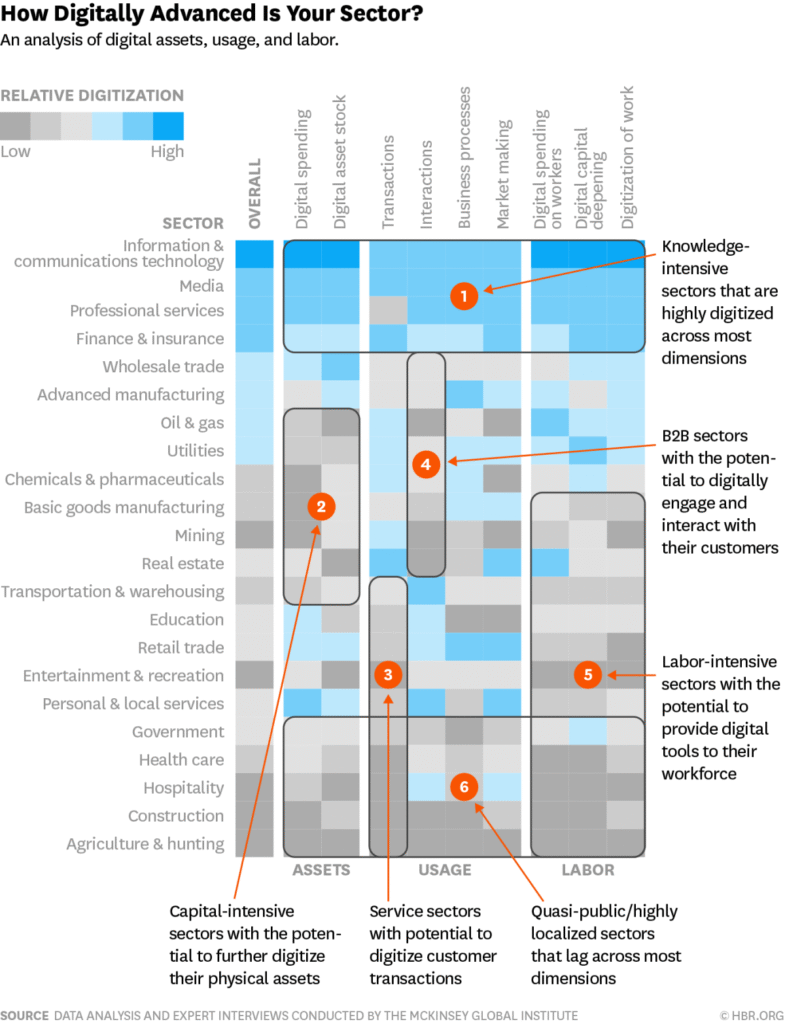
Gartner defines ‘digitization’ as: “the process of changing from analog to digital form.” and ‘digitalization’ as “the use of digital technologies to change a business model and provide new revenue and value-producing opportunities; it is the process of moving to a digital business.”
In addition, the 2015 Digital Business Global Executive Study and Research Project by MIT Sloan Management Review and Deloitte identifies strategy as the key driver in the digital arena: “Strategy, not Technology, Drives Digital Transformation“.
Based on these concrete paradigm shifts in today’s real world and the theoretical framework that I previously drafted here, one could easily understand why I did not follow standard management studies at a business school or classical science studies at an engineering school. I rather chose to study international strategy, international business law, international economics, international management, international marketing and internationalization at the Université Paris 1 Panthéon-Sorbonne and international communication, media studies, global studies, sociology, digital sociology, the sociology of the Internet, the social shaping of technology and the domestication of ICTs at LSE – The London School of Economics and Political Science to gain an essential, critical and deep pluridisciplinary understanding of the cultural and creative industries, digitalization and globalization.