“To study and not think is a waste. To think and not study is dangerous.“
Confucius
“Education is not solely about earning a great living. It means living a great life.”
Brad Henry
Contents
1. Education Summary
“Live as if you were to die tomorrow. Learn as if you were to live forever.”
Often misattributed to the great Mahatma Gandhi.
1.1 Objective
“Rerum cognoscere causas“
“To understand the causes of things“
Motto of the London School of Economics and Political Science (1895).
My objective was to understand our digital and global modern society disrupted by digitalization and globalization. And to acquire “une double compétence” as we say in French, a dual expertise: a functional expertise (in management, marketing, and strategy) and an industry expertise (in entertainment, media, and technology) to work for a top consulting firm as a young graduate (which I managed to do by later joining Accenture).
While a young teenager studying at the Collège and Lycée Charlemagne in le Marais in Paris (one of the oldest and best public high schools in France, founded by Napoléon Bonaparte in 1804), I designed early on a special curriculum to develop some core competencies through a unique academic education (described below) in management studies, media studies, and global studies, and an international professional experience in the cultural and creative industries, in order (1) to fulfill my lifelong passions for arts, culture, media, and entertainment every single day, (2) to answer the current and future needs for specific hard skills and soft skills in the creative economy, and (3) to accompany creators and organizations of the cultural and creative industries in their digital transformation and internationalization to meet the challenges and to seize the opportunities of the digital revolution.
1.2 Six top universities
“Hic et ubique terrarum”
“Ici et partout sur la Terre”
“Here and anywhere on Earth”
Motto of the University of Paris (the second-oldest university in the world).
I was trained by six of the best universities in the world for arts, humanities, social sciences and management, for a truly global experience.
These world-leading teaching and research institutions are among the most prestigious global universities:
- in the French-speaking world, Université Paris 1 Panthéon-Sorbonne (UP1),
- in the Spanish-speaking world, Universidad Complutense de Madrid (UCM),
- in the English-speaking world, the London School of Economics and Political Science (LSE), the University of California, Los Angeles (UCLA) and Harvard University,
- and in Asia, 复旦大学 – Fudan University in Shanghai (FDU).
As a professional, I also studied at one of the top communication schools in France, EFAP, and at one of the top language schools, INALCO.
In the QS World Ranking: Social Sciences and Management, Harvard was ranked first and LSE second for 9 consecutive years, from 2013 to 2021.
1.3 Ten main disciplines
“Go to bed smarter than when you woke up.”
“I constantly see people rise in life who are not the smartest, sometimes not even the most diligent, but they are learning machines. They go to bed every night a little wiser than they were when they got up.”
Charlie Munger
Management studies and media studies are inherently interdisciplinary (drawing on other social science disciplines such as economics, psychology, sociology, anthropology, and political science). Therefore, I benefited from a truly multidisciplinary education across various disciplines of the social sciences and the humanities rather than an education focused on a single area of specialization (like marketing management). At every top university where I studied (University of Paris 1 Panthéon-Sorbonne, Complutense University of Madrid, the London School of Economics and Political Science, and Fudan University), pluridisciplinarity, and interdisciplinarity were highly valued and central to the curriculum. I believe that such education, going well beyond a basic business degree, is better suited for the world leaders, creative entrepreneurs, top media executives, and global media managers of the 21st century. Moreover, in the age of AI, I do not believe in hyperspecialization but rather in pluridisciplinarity and transdisciplinarity.
I received a multidisciplinary, interdisciplinary, and transdisciplinary education in many academic disciplines of the social sciences and the humanities:
- Management, business administration, international business management, business internationalization, cross-cultural management, operations research, management science, game theory, mathematics, statistics, probability, quantitative analysis, decision analysis, decision making, problem solving, accounting, financial accounting, management accounting or managerial accounting, cost accounting, tax accounting, financial reporting, auditing, production management, logistics, supply chain management, industrial relations, labor relations, human resource management (HRM), talent management, conflict management, conflict resolution, negotiation, change management, digital transformation and media management,
- Economics, business economics, managerial economics, organizational economics, international economics, macroeconomics, microeconomics, behavioral economics, financial economics, monetary economics, national accounting, economic history, the history of economic thought, finance, corporate finance, financial markets, mathematical finance, international finance, financing strategy, investment strategy, international trade, foreign trade, taxation, tax policy, fiscal policy, economic sociology, the socioeconomics of the cultural and creative industries and media economics,
- Organization studies, organizational theory, organizational behavior, organizational culture, organization development, organizational design, psychosociology, the social psychology of organizations, industrial and organizational psychology, organizational intelligence and mass media,
- Strategy, strategic management, international strategy, corporate strategy, business strategy, functional strategy, operational strategy, strategic intelligence, competitive intelligence, marketing intelligence, market intelligence, business intelligence, digital strategy and media strategy,
- Marketing, marketing management, international marketing or global marketing, marketing strategy, marketing plan, marketing communications, advertising, promotion, digital marketing or e-marketing or Internet marketing or online marketing or web marketing, rhetoric, linguistics, discourse analysis, literary theory, semiotics, semiology, psychology, media psychology, media influence, media culture and pop culture,
- Law, business law or commercial law, corporate law, contract law, financial law, corporate governance, public law, administrative law, tax law, international law, comparative law (common law or case law vs. civil law or European law), philosophy, ethics, business ethics, human rights and media regulation,
- Political science, international relations/international studies/international politics/international affairs, global politics/world politics, geopolitics, geostrategy, geoeconomics, political economy, the political economy of communication, media conglomerates, media capture, censorship, freedom of speech, freedom of the media, media pluralism, public policy and media policy,
- Sociology, social theory, social research, women’s studies, feminist studies, gender studies, ethnic studies, postcolonial studies, decolonial studies, anthropology, social anthropology, cultural anthropology, sociocultural anthropology, ethnography, ethnology, history, marxism, critical theory, the culture industry, post-structuralism, postmodernism and cultural studies,
- Communication studies, journalism, information science, history of the media, history of journalism, history of broadcasting, history of television, broadcast programming, mediatization, media ecology, media sociology, digital sociology, the sociology of the Internet, Internet studies, media and everyday life, the social shaping of technology, the domestication of information and communication technologies or ICTs, new media studies and media studies,
- Global studies, globalization, economic globalization, cultural globalization, cultural imperialism, cultural homogenization, Americanization, Westernization, cultural diversity, cultural pluralism, multiculturalism, enculturation, acculturation, hybridization, glocalization, transnationalism, cosmopolitanism, globality, global citizenship, classical and modern languages (Latin, French, English, Spanish, Mandarin Chinese and Russian), media and globalization, media imperialism, digital imperialism or digital colonialism or electronic colonialism, and global media.
1.4 Six academic degrees
“If you stop learning in this world, the world rushes right by you.”
“Develop into a lifelong self-learner through voracious reading; cultivate curiosity and strive to become a little wiser every day.”
Charlie Munger
I have six degrees including four master’s degrees: Master of Management, Master of Science, Master of Arts, and Master of Business Administration.
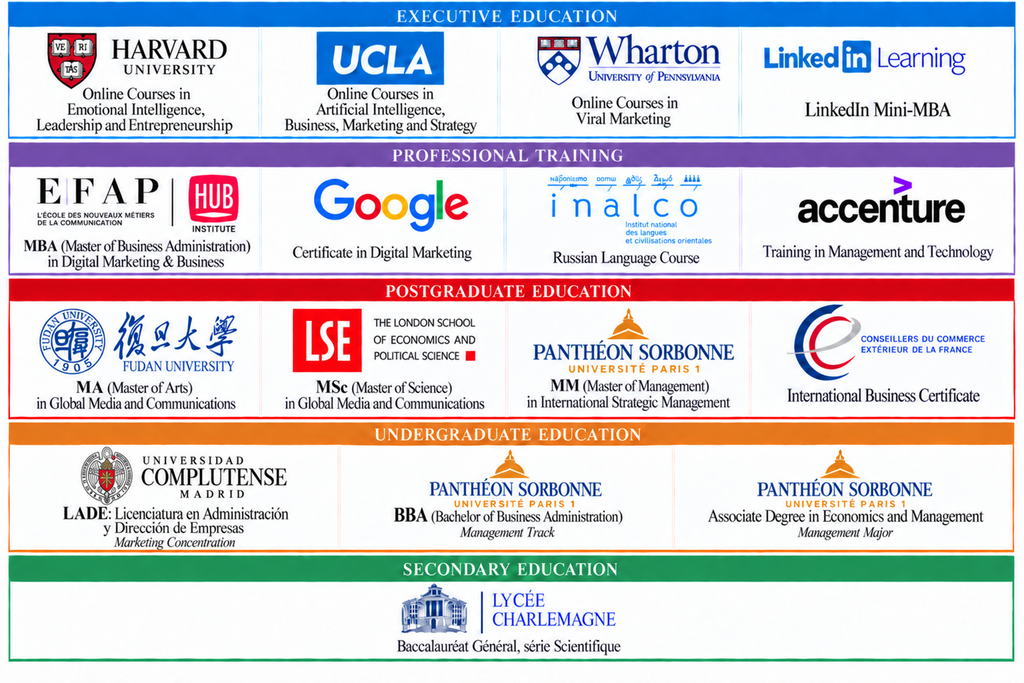
Executive summary of the education and training I pursued over the years across different academic traditions, disciplines, cultures, and countries
Executive Education
Twenty years after my Sorbonne Master’s degree in International Strategic Management (M2 MSI, “the Sorbonne MBA”) and ten years after my EFAP – HUB Institute Specialized MBA in Digital Marketing & Business (MBA DMB, #InsideDigitalRevolution), I decided to go back to school in 2026 to refresh my knowledge, to update my software, and to study business administration, strategy, management, leadership, change management, negotiation, communication, marketing, finance, entrepreneurship, innovation, technology, data, design thinking, and product design in the age of artificial intelligence and generative and agentic AI. As a former MBA and Executive Education Adjunct Professor, I designed a modern, innovative, cutting-edge, state-of-the-art, 100% customized, and hyper-personalized, AI-powered executive education program, which best matches my profile and needs as an entrepreneur and global manager. Through a combination of carefully curated online courses from Harvard, UCLA, Wharton, and LinkedIn:
- 2026-now: Online courses in leadership, entrepreneurship, and emotional intelligence from Harvard University, World #1 for Business (QS 2026).
- 2026-now: Online courses in artificial intelligence, business, marketing, and strategy at UCLA, the best or second-best public university in the US.
- 2026: Online courses in viral marketing from the Wharton School of the University of Pennsylvania, which offers the world’s best MBA (QS 2026).
- 2026: LinkedIn Mini-EMBA – I designed my own online Executive MBA by taking the best MBA-level courses (including AI) on LinkedIn Learning.
In total, this management + technology online executive program, with a strong focus on leadership and AI, represents hundreds and hundreds of hours of online training. #AlwaysLearning #NeverStopLearning #LifelongLearner #LifelongStudent
Professional Training
- 2016-2017: EFAP Specialized MBA in Digital Marketing & Business, valedictorian/major de promotion. Ranked 2nd among the best master’s degrees in digital marketing and e-business in France for many years (including in 2024). Founded in 2015 by Vincent Montet (the founder of the oldest MBA in Internet marketing and e-commerce in France in 1998) and the HUB Institute (a leading digital think tank, consulting firm and training firm in digital transformation and AI), the MBA DMB #InsideDigitalRevolution was the first master’s program and MBA on the digital revolution and digital transformation in France. The digital marketing and e-business courses and masterclasses were led entirely by professionals, all superstars in their fields (e-commerce, SEO, SEA, social media, analytics, UX, UI, mobile marketing, email marketing, CRM, CX, martech, marketing automation, etc.). Intensive Google Ads (formerly known as Google AdWords) and Google Analytics training from two of Google France’s main official trainers. I used to see Jonathan Vidor and Aymerik Bouchacourt from JVWEB in Google France’s official training videos, and I had them right in front of me during my MBA classes. I was also trained in SEO (Search Engine Optimization) by the great Yann Lemort. I was part of the second cohort of this innovative and transformative MBA, preparing me for the future of humanity, society, business, and marketing in the age of AI (artificial intelligence) and robots.
- 2016: Google Certificate in Digital Marketing, approved by IAB Europe (Interactive Advertising Bureau). This was my first Google training course in digital marketing and e-commerce. I did this online training and obtained this Google certificate for professionals (Google pour les Pros) before my MBA.
- 2013-2014: INALCO Russian language course. Part-time evening course for professionals. INALCO is the only school in the world to teach more than 100 languages and civilizations. INALCO has the largest Russian language department in France and Europe, with over 700 students in Russian studies.
- 2011-2012: Accenture corporate training in management and technology every week (the world’s largest business & technology consulting firm).
Postgraduate Education
- 2008-2009: Fudan MA in Global Media and Communications. Ranked #1 among the top master’s degrees in communication in Asia for many years. Launched in 2007-2009, I was part of the first cohort of this new LSE-Fudan double degree creating a very important path between Europe and China. In 2008, I was chosen to deliver the inaugural speech during the official opening ceremony in Shanghai of this first double degree between LSE and Fudan. This program focused primarily on the history of journalism and media in China, the comparative study of Chinese and Western media, and marketing strategy and marketing communications in China. I studied at the four departments of Journalism, Broadcasting, Communication, and Advertising of the prestigious Fudan School of Journalism, at the Department of World Economy of the Fudan School of Economics, and at the Department of Sociology of the Fudan School of Social Development and Public Policy for a multidisciplinary study and understanding of Chinese culture, media and society. Fudan has been ranked first for communication in mainland China (Shanghai Ranking 2025) and second for marketing after Tsinghua (QS 2025).
- 2007-2008: LSE MSc in Global Media and Communications. Ranked #1 among the top master’s degrees in communication in Europe for many years. The brainchild of LSE’s former director Anthony Giddens, this is the world’s oldest degree in global media, founded in 2000 by Terhi Rantanen at LSE and by Patricia Riley at USC (University of Southern California). This is also the oldest and the largest double degree at the London School of Economics and Political Science. LSE was ranked second among the best universities in the world for communication and media studies, tied with USC but ahead of Harvard, Penn, Stanford, NYU, Cambridge, Berkeley, Columbia, Goldsmiths, Northwestern, MIT, UCLA, King’s College, Yale, Cornell, and UCL (QS 2024). The topics of the digital transformation and globalization of the media and entertainment industry were at the heart of this innovative program.
- 2007: International Business Certificate with honors of the French Foreign Trade Advisors (Conseillers du Commerce Extérieur de la France/CCE).
- 2006-2007: Sorbonne Master’s degree in International Strategic Management, summa cum laude, valedictorian/major de promotion. Ranked 1st or 2nd among the best master’s degrees in strategy and consulting in France for many years (including in 2026), ahead of the master’s degrees (MSc) of all the top private business schools: HEC Paris, ESCP Business School, EDHEC Business School, and emlyon business school. With an acceptance rate of only 5% (over 400 applications each year for 20 admitted students). Until 2000, the Sorbonne School of Management did not offer a master’s degree in corporate strategy and general management, but rather highly specialized master’s degrees in very specific subfields of management (accounting, audit, finance, marketing, sales, logistics, human resource management, etc.). Hubert de La Bruslerie, the Director of the Sorbonne School of Management and Convenor of the Sorbonne Bachelor of Business Administration, decided to create the first master’s degree in management and strategy at the Université Paris 1 Sorbonne in 2000, modeled after the best American MBAs. He even called this DESS/Master 2 Management Stratégique International: “the Sorbonne MBA”. This generalist program was structured around two main pillars: strategic management and international management. Its aim was to develop essential cross-functional skills for all the sectors of the 21st-century economy, training the global business leaders of tomorrow.
- 2005-2009: Chinese language courses for three years. In 2005-2006 in Madrid, in 2007-2008 in London (LSE) and in 2008-2009 in Shanghai (Fudan).
Undergraduate Education
- 2005-2006: Complutense LADE – Licenciatura en Administración y Dirección de Empresas (a five-year Spanish degree that no longer exists, equivalent to a Master of Business Administration or MBA), especialidad en Dirección Comercial y Marketing (Marketing concentration). The Complutense MBA has been ranked 1st among all public universities in Spain for many years and 4th overall after Spain’s best private business schools: ESADE, IESE and IE. Erasmus year, the European Union‘s international student exchange program (non-degree program, I was still officially a student at the Sorbonne).
- 2004-2006: Sorbonne Bachelor of Business Administration, Management track, magna cum laude. Ranked 1st or 2nd among the best BBAs (Bachelors of Business Administration and General Management) in France for many years by multiple rankings. Université Paris 1 Panthéon-Sorbonne is the best university for social sciences and management in France and 3rd overall after the two private business schools INSEAD and HEC Paris but ahead of Sciences Po Paris, ESSEC, Université PSL (including ENS – École normale supérieure de la rue d’Ulm and Université Paris Dauphine), ESCP, Sorbonne Université, emlyon, EDHEC, Institut Polytechnique de Paris and Université Paris-Saclay (QS 2022, QS 2023, QS 2024, QS 2025 and QS 2026).
- 2002-2004: Sorbonne Associate degree in Economics and Management, Management major, magna cum laude. A founding member of the Paris School of Economics (PSE), Université Paris 1 Panthéon-Sorbonne is the best university for economics in France ahead of Institut Polytechnique de Paris, Université Toulouse 1 Capitole, Université PSL – Université Paris Sciences et Lettres (including ENS – École normale supérieure de la rue d’Ulm and Université Paris Dauphine), Sciences Po, HEC Paris, Université Paris-Saclay, ESSEC, EDHEC, emlyon, EHESS and ESCP (QS 2024, QS 2025 and QS 2026).
Secondary Education
- 2002: Baccalauréat Général, série Scientifique (première scientifique et terminale scientifique). Similar to the final high school diploma in the US. The “Baccalauréat ès sciences” created by Napoléon Bonaparte in 1808, became “Baccalauréat général : série Scientifique” or “Bac S” between 1995 and 2020. The scientific series or S stream of the French General Baccalaureate was considered the most difficult, the most selective and the most prestigious baccalaureate in France, reserved for the best students of French lycées/high schools. The scientific baccalaureate was abolished by the Macron government in 2020 to promote inclusivity rather than elitism and to end the hierarchy between the Baccalaureate tracks (S, L, ES). The Bac S was considered “la voie royale” (“the royal road”) in France, and selection for higher education in France was based primarily on students’ level in science, and particularly in mathematics. Without this scientific baccalaureate, I would not have succeeded in my ultra-selective management studies at the Université Paris 1 Panthéon-Sorbonne where the level in mathematics, probability, statistics, and quantitative analysis was very high, with a highly selective admissions process to keep only the very best students, “la crème de la crème” (“the cream of the crop”), each year, from L1 (Y1) to M2 (Y5).
- 1995-2002: Collège Charlemagne and then Lycée Charlemagne (in Paris). This is equivalent to school from 6th grade to 12th grade in the US system. The prestigious Collège and Lycée Charlemagne in le Marais is one of the best middle schools and high schools in France. A 100% free public school, Charlemagne is one of the four oldest high schools in Paris. The origins of the school date back to 1264 with a beguinage founded by Saint Louis on the current location of the lycée Charlemagne. The site then became the Hôtel de la Rochepot / Hôtel de Damville, then the very prestigious Maison professe des Jésuites or Maison professe de Paris (1580-1762), then the prestigious école centrale de la rue Saint-Antoine (1797-1803), and finally, it became the Lycée Charlemagne in 1804. In 1802, Napoléon Bonaparte established fourty five lycées throughout France, including four lycées in Paris: the Lycée Impérial (now Lycée Louis-le-Grand), the Lycée Napoléon (now Lycée Henri-IV), the Lycée Bonaparte (now Lycée Condorcet), and the Lycée Charlemagne. Napoléon Bonaparte saw himself as the heir of Charlemagne (King of the Franks who later became Emperor and is considered “the Father of Europe”).
2. Education History
In this second part, you will discover the (non-exhaustive) list of courses I have taken and the names of some of my exceptional teachers over the years.
Dual Academic Foundation: Management Studies at Université Paris 1 and Media Studies at the London School of Economics and Political Science
Some of my prominent professors at the Sorbonne
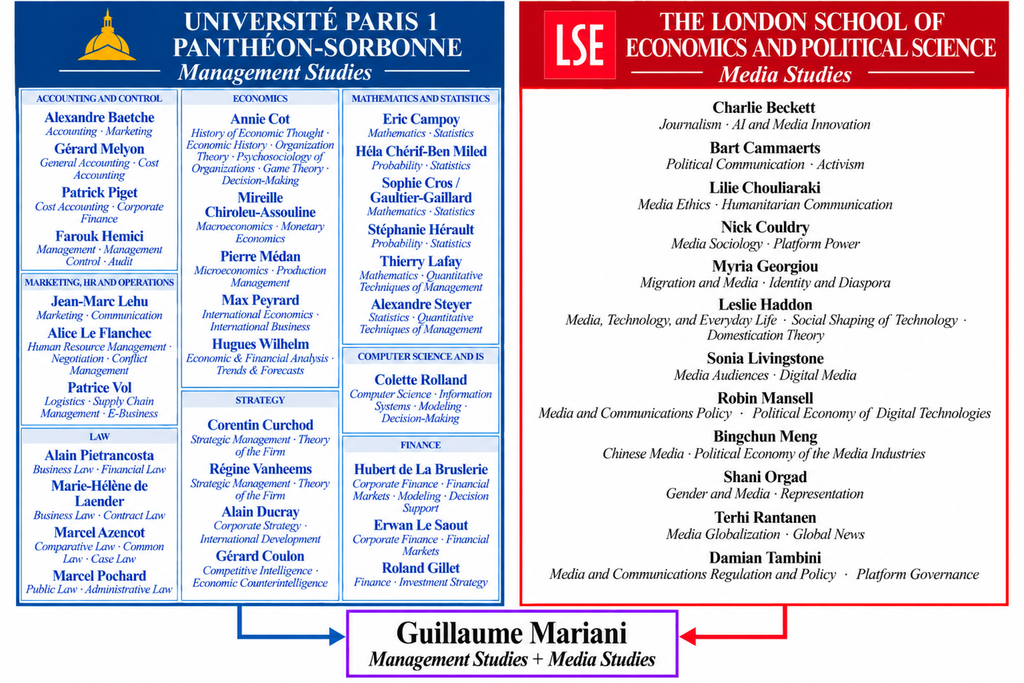
I was trained at the Université Paris 1 Panthéon-Sorbonne in Accounting by Alexandre Baetche (disciple of Pierre Lassègue), Gérard Melyon (disciple of Jean-Richard Sulzer), and Patrick Piget (disciple of Francine Roure, visiting scholar at the MIT Sloan School of Management who also taught at the Kellogg Graduate School of Management at Northwestern University), in Management, Management Control, and Audit by Farouk Hemici (disciple of Nguyen Huu Chau), in History of Economic Thought, Economic History, Organization Theory, Psychosociology of Organizations, Game Theory, and Decision-Making by Annie Cot (disciple of Hubert Brochier), in Macroeconomics and Monetary Economics by Mireille Chiroleu-Assouline (disciple of Paul Zagamé), in Microeconomics and Production Management by Pierre Médan (disciple of Jean Parent), in International Economics and International Business by Max Peyrard (1972-1973 Fulbright Visiting Scholar at Harvard University and MIT – Massachusetts Institute of Technology, disciple of Maurice Byé), in Marketing by Alexandre Baetche, in Marketing and Communication by Jean-Marc Lehu (disciple of Henri Mercillon and Pierre Grégory, 1969 University of Pennsylvania alumnus), in Human Resource Management, Conflict Management, and Negotiation by Alice Le Flanchec (disciple of Jacques Rojot, 1976 PhD from UCLA), in Business Law, Contract Law, and Financial Law by Alain Pietrancosta (disciple of Yves Guyon) and Marie-Hélène de Laender (disciple of Christian Gavalda), in Strategic Management and Theory of the Firm by Corentin Curchod (disciple of Hervé Dumez from École Polytechnique) and Régine Vanheems (disciple of Francis Salerno), in Mathematics, Probability, Statistics, and Quantitative Techniques of Management by Eric Campoy (disciple of Jacques Rojot, 1976 PhD from UCLA), Héla Chérif–Ben Miled (disciple of Christian Pinson from INSEAD and Université Paris Dauphine, 1978–1979 Visiting Scholar at UCLA, 1972 Master of Arts in Sociology and 1981 PhD in Marketing from Northwestern University, under Brian Sternthal, and also a doctoral student of Sidney J. Levy), Sophie Cros / Gaultier-Gaillard (disciple of Bertrand Munier, who was the disciple of Oskar Morgenstern at Princeton University and of Martin Shubik at Yale University), Stéphanie Hérault (disciple of Pierre Grégory, 1969 University of Pennsylvania alumnus), Thierry Lafay (disciple of Jean-Pierre Ponssard from École Polytechnique, 1971 PhD from Stanford University), and Alexandre Steyer (disciple of Gilles Laurent from HEC Paris, 1978 PhD from MIT – Massachusetts Institute of Technology), in Computer Science and Information Systems by Colette Rolland (disciple of Jean Legras), and in Finance, Corporate Finance, Financial Markets, Financing Strategy, and Investment Strategy by Hubert de La Bruslerie (disciple of Pierre Conso and Yves Simon from Université Paris Dauphine), Erwan Le Saout (disciple of Patrick Navatte), and Roland Gillet (1989-1990 visiting fellow at the Harvard Kenneth C. Griffin Graduate School of Arts and Sciences, the Harvard Business School, and the MIT Sloan School of Management, disciple of Alexis Jacquemin from UCL – Université Catholique de Louvain and of Franco Modigliani from MIT – Massachusetts Institute of Technology, 1985 Nobel Prize in Economics).
I received multidisciplinary training in decision-making from the perspectives of economics with Annie Cot, management with Farouk Hemici, information systems with Colette Rolland, marketing with Jean-Marc Lehu, finance with Hubert de La Bruslerie, and strategy with Alain Ducray.
I chose the management track of the Sorbonne BBA, but my friends who chose the finance track at the Sorbonne School of Management (MSG finance, IUP de gestion financière, magistère finance) were also trained by the most distinguished professors of finance in France, such as Christian de Boissieu (UFR 02), Patrick Artus (UFR 02), Patrice Poncet (UFR 06), Robert Goffin (UFR 06), Philippe Raimbourg (UFR 06), Jacques Chrissos (UFR 06), Christophe Hénot (UFR 06), and Francine Roure (UFR 27). Some of my friends were also trained in HRM by Jean-François Amadieu (UFR 06) and Charles-Henri d’Arcimoles (UFR 06), and in labor law by Jean-Emmanuel Ray (UFR 06). The ideas of Pierre Grégory (management, marketing and consumer behavior) and Jacques Rojot (organization theory, industrial relations, negotiation, and human resource management), Foreign/Overseas Correspondent for France of the U.S. National Academy of Arbitrators (NAA) and President of the Paris Section of the Industrial Relations Research Association (IRRA, now the Labor and Employment Relations Association, LERA), were everywhere throughout my studies, but unfortunately, they had left Université Paris I Panthéon-Sorbonne for Université Paris II Panthéon-Assas by the time I arrived at the Sorbonne. I had enrolled in management at Université Paris 1 at the age of 17 specifically to study under both of them. However, I was trained by Jean-Marc Lehu, a disciple of Pierre Grégory; Alexandre Steyer, the institutional and intellectual successor to Pierre Grégory; Eric Campoy, a disciple of Jacques Rojot; and Alice Le Flanchec, the intellectual heir and institutional successor to Jacques Rojot, former editor-in-chief and current member of the scientific direction board of the RGRH – Revue de Gestion des Ressources Humaines (Human Resource Management Review), founded by Jacques Rojot in 1991, and a member of the editorial board of @GRH, the journal of the AGRH – Association Francophone de Gestion des Ressources Humaines (Francophone Association for Human Resource Management).
Some of my prominent professors at LSE
I was trained at the London School of Economics and Political Science, the school of Anthony Giddens and Roger Silverstone, in Sociology, Political Economy, Media, and Communications by Charlie Beckett (journalism, networked journalism, artificial intelligence and journalism, media innovation, political communication, and media economics), Bart Cammaerts (political communication, activism and protest, alternative media, power, and participation), Lilie Chouliaraki (mediation of human vulnerability and suffering, humanitarian communication, media ethics, representations of suffering and violence, migration, and war and conflict reporting), Nick Couldry (Faculty Associate at the Berkman Klein Center for Internet & Society at Harvard University since 2017, media sociology, social theory, media and platform power, data colonialism, critical AI studies, and media and data ethics), Myria Georgiou (migration and media, urban communication, identity and diaspora, and transnational communities), Leslie Haddon (media, technology and everyday life, social shaping of technology, ICT domestication, and children and digital technologies), Sonia Livingstone (2013–2014 faculty fellow at the Berkman Center for Internet & Society at Harvard University, media audiences, media literacy, children and digital media, digital rights, digital inequality, and online risks and safety), Robin Mansell (media and communications policy, internet governance, digital platforms, platformisation and datafication, privacy and surveillance, and the political economy of digital technologies), Bingchun Meng (political communication, political economy of the media industries, communication governance, comparative media studies, China, and gender and media), Shani Orgad (gender and feminism, media representation, inequality, migration, globalization, and narrative), Terhi Rantanen (visiting scholar at Harvard University and the University of Oxford, media globalization, global news, news agencies, media history, history of media studies, and comparative media research), and Damian Tambini (associate fellow at the Oxford Internet Institute, media law, media policy, media regulation, democratic communication, media freedom, media pluralism, telecommunications, and digital platform governance).
The Sorbonne and LSE academic and intellectual foundations of my research on leadership in the age of AI
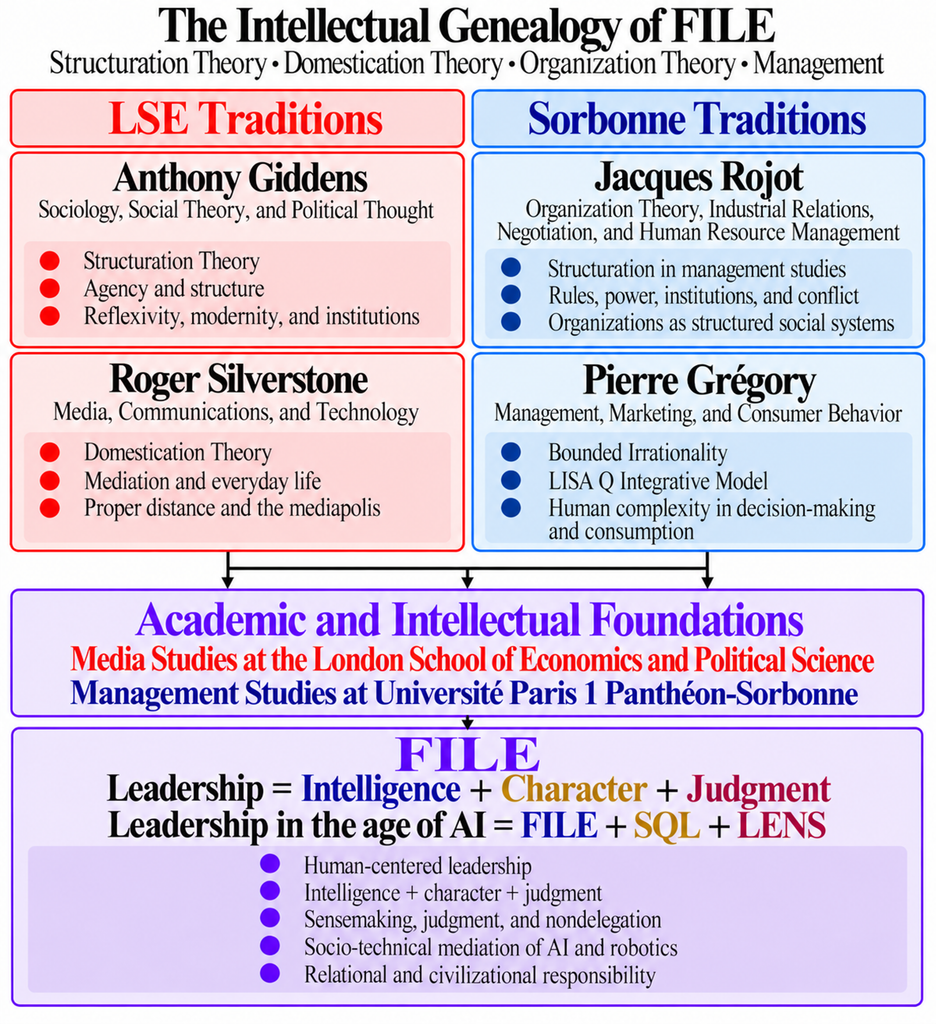
My academic formation therefore stands at the convergence of four major intellectual traditions that profoundly shaped my thinking: Pierre Grégory’s tradition in management and marketing, Jacques Rojot’s tradition in organization theory, industrial relations, negotiation, and human resource management, Anthony Giddens’s tradition in social theory and structuration, and Roger Silverstone’s tradition in media, communications, and technology. The connection between the Sorbonne and LSE traditions is particularly strong through Jacques Rojot, who played an important role in introducing, developing, and applying Anthony Giddens’s theory of structuration within French organization and management studies. Rojot published the journal article La théorie de la structuration (The Theory of Structuration) as early as 1998, followed in 2000 by the book chapter La théorie de la structuration chez Anthony Giddens (Anthony Giddens’s Theory of Structuration), in a volume devoted to structuration and the management of organizations, and returned to Giddens’s work again with the chapter Anthony Giddens, La théorie de la structuration (Anthony Giddens: The Theory of Structuration), first published in a collective volume in 2012 and subsequently published separately as an ebook in 2013. My formation at Paris 1 and LSE thus did not simply bring together two separate academic traditions: it placed me at the intersection of intellectual traditions that were already deeply connected through the transmission of Anthony Giddens’s social theory and structuration into French management and organization studies. My research on leadership in the age of AI grows directly from this convergence of the Sorbonne traditions of management and organization theory, Giddens’s social theory, and Silverstone’s domestication theory. Obviously, my research also draws on the online training that I received in leadership and emotional intelligence from Harvard University (HarvardX) and in artificial intelligence and global business from UCLA Extension (UCLAxOpen).
2026-now: Harvard University online courses in leadership, entrepreneurship, and emotional intelligence
My objective was to study emotional intelligence as a leader and the important influence of EI or EQ on leadership and entrepreneurship.
I studied business and management for five years at the University of Paris 1 Panthéon-Sorbonne and at the Complutense University of Madrid but I never had one course, or even one lecture or one class, on leadership, entrepreneurship, and emotional intelligence. These fundamental skills were not taught during my management studies in 2002-2007 to my great regret. I have been an entrepreneur and business leader since the age 20 but it was important for me to receive formal training on these crucial topics from the best university in the world. I truly believe that these essential leadership, entrepreneurship, and emotional intelligence skills in the age of AI are making me not only a better professional, a better manager, a better executive, a better entrepreneur, and a better leader, but also a better man, a better person, and a better human being on a personal level.
Online courses in leadership and management, entrepreneurship and business, and emotional intelligence and mental health, from:
- the John F. Kennedy School of Government or Harvard Kennedy School (HKS),
- the Harvard Business School (HBS),
- the Harvard Medical School (HMS),
- the Harvard T.H. Chan School of Public Health (HSPH),
- the Harvard Kenneth C. Griffin Graduate School of Arts and Sciences (GSAS),
- and the Harvard Faculty of Arts and Sciences (FAS).
List of completed HarvardX courses (non-degree):
- Leadership and management:
- Exercising Leadership: Foundational Principles (by Ronald Heifetz, Founding Director of the Center for Public Leadership and King Hussein Bin Talal Senior Lecturer in Public Leadership at the Harvard Kennedy School)
- Coming soon (ongoing)
2026-now: UCLA live online courses in artificial intelligence, global business, marketing, and entertainment
Live online courses at UCLA Extension. University of California, Los Angeles.
My objective was to study artificial intelligence as a business leader and how AI is transforming and will transform business, marketing, and strategy.
List of completed UCLAxOpen courses (non-degree, live webinars):
- AI in Global Business: Strategy, Transformation, and Responsible Innovation. How AI Transforms Strategy, Markets, and Organizations (by Roberto Alvarez Landeros)
- AI for Marketers: Building Your Own Custom GPT & Simple Automations. How to Build Simple and Effective AI Tools (by Antonio Pagano)
- What Human Readers Add to Script Evaluation, and How Writers Can Leverage It (by Cody Smart)
- Beyond RAG: Building AI Agents That Think, Plan, and Act (by Vyoma Gajjar)
- AI and Technology in Global Trade and Logistics (by Ashok Sadhwani and Vicky Panossian)
- Marketing in the Age of AI Agents: SEO, Automation, & Strategy (by Antonio Pagano)
- The Data Behind Modern AI (by Steve Anderson)
- Running a Local LLM: AI on Your Own Computer (by Antonio Pagano)
- TV Development Now: Turning Industry Disruption into Opportunity (by Anna Henry)
- Introduction to Being a Showrunner (by Joel Anderson Thompson)
- Beyond Grades in the Age of AI: New Ways to Assess Thinking, Creativity, and Learning (by Tina R. Austin)
- The Human Side of AI: Designing, Working, and Living in an AI-Driven World (by Robert K. Atkinson)
- To be updated (ongoing)
2026: Online courses in viral marketing by the great Jonah Berger from the Wharton School of the University of Pennsylvania
Online courses (non-degree) on LinkedIn Learning (1 hour) and Coursera (6 hours).
LinkedIn Learning Certificate: https://www.linkedin.com/learning/certificates/95d82b2a38b2ef3900630aba42e4f1fd9cae2dd0525b15d6a84b7d95d7240927?trk=share_certificate

2026: I designed my own online Executive MBA by taking the best MBA-level courses on LinkedIn Learning
List of completed courses (non-degree):
- A Mini-MBA for Those Considering a Top MBA Program (LinkedIn Learning Path. Updated August 2025):
- What They Don’t Teach You at Harvard Business School (by Blinkist, based on Mark Hume McCormack’s 1984 book)
- Super Connecting: The Secret of Professional Networking (by Madecraft and JaMarr John Johnson)
- Finance Foundations (by Kay Stice and Jim Stice, both famous Emeritus Professors of Acccounting at BYU – Brigham Young University. Kay Stice is the PricewaterhouseCoopers Professor of Accounting at the BYU Marriott School of Management and has been an Executive MBA lecturer at the Hong Kong University of Science and Technology (HKUST), the China Europe International Business School (CEIBS) and INSEAD. Jim Stice is the Distinguished Teaching Professor of Accounting in the School of Accountancy at Brigham Young University (BYU) and has taught at INSEAD in both France and Singapore and CEIBS in China)
- Developing a Competitive Strategy (by Anil Gupta, a leading scholar in management and business strategy and Michael D. Dingman Chair in Strategy, Globalization, and Entrepreneurship at the University of Maryland, College Park’s Robert H. Smith School of Business)
- A Modern Guide to Strategy Implementation (by Antonio Nieto-Rodriguez, “The World’s Champion in Project Management”, former Chairman of the Project Management Institute (PMI), author of “the Harvard Business Review Project Management Handbook” in 2021, Director and Professor of IE’s Flagship Program: Strategic Project Management for Executives at IE Business School (Instituto de Empresa) and Professor of Project Management & Strategy Implementation at the Solvay Brussels School of Economics and Management)
- Leading with Innovation in the Age of AI (by Anil Gupta again and Haiyan Wang, Managing Partner of the China India Institute and adjunct professor of strategy at INSEAD)
- To be updated (ongoing)


2016-2017: Specialized MBA (Master of Business Administration) in Digital Marketing & Business (DMB), valedictorian/major de promotion
EFAP and HUB Institute with IAB (Interactive Advertising Bureau), MMA (Mobile Marketing Association), Fevad, ACSEL, UDA, AACC…
- EFAP (a top communication school in France), the HUB Institute (the first digital think tank in France, helping companies to successfully achieve their digital transformation) and Sorbonne alumnus Vincent Montet (the founder and former director of the oldest French MBA in Internet marketing and e-commerce, MBA MCI, dating back from 1998) combined their 17 years of experience in the digital education of students and in the digital training of professionals to create the first MBA in France specialized in the digital transformation of our contemporary economy and society in 2015 with prestigious partners representing the entire French digital ecosystem: IAB France (Interactive Advertising Bureau), MMA France (Mobile Marketing Association), Acsel (l’Association de l’économie numérique et hub de la transformation digitale), Fevad (la Fédération du e-commerce et de la vente à distance), Sncd (le Syndicat national de la communication directe), CPA (le Collectif de la performance et de l’acquisition), UDA (l’Union des annonceurs), AACC (Association des Agences-Conseil en Communication), EuraTechnologies (the leading startup accelerator and incubator in France and in the European Top 10 located in Lille), Darwin (tech startup hub of Bordeaux) and La Cuisine du Web (tech startup hub of Lyon).
- The MBA DMB is the official partner of the biggest digital events in France and in Europe: Microsoft Experiences (former TechDays), HUB Forum, etc. It is the only French master’s degree with such exclusive partnerships #InsideDigitalRevolution (motto, slogan and tagline of the MBA DMB).
- Exclusive Master Classes by prestigious guest speakers (CEOs, CMOs, CDOs, CDMOs and CTOs) from the GAFAM (Google, Apple, Facebook, Amazon and Microsoft) and from Twitter, InMobi… For example: the General Director of Facebook France and Regional Director of Facebook Southern Europe, the Chief Digital Marketing Officer (CDMO) of Microsoft France, the Brand Strategy Lead of Twitter France, the General Director of RTL Net, the Content Strategy Director of Orange, etc.
- As the first MBA specialized in digital transformation in France, this very intensive program covers all the areas of digital marketing (including Internet marketing, mobile marketing, search marketing, social media marketing, email marketing, programmatic marketing, RTB, CRM, analytics,…), e-business (including e-commerce, m-commerce, digital project management, user experience design, customer experience, social selling, web-to-store,…) and cutting-edge technologies (NFC, 3D printing, IoT, big data, cloud, robotics, artificial intelligence, machine learning, chatbots, voice search, e-health, augmented reality, virtual reality, blockchain…)
- All the classes are exclusively taught by very experienced professionals, all rock stars in their fields (SEO, SEA, SMM, emailing, mobile apps, UX, CX…). Only recognized professionals and no academics.
- You can find the complete list of all my MBA DMB courses and professors in my 2017 LinkedIn article (in French): What is digital marketing?
The MBA DMB has been ranked #2 in the ranking of the best MBAs and Master’s degrees in Digital Marketing and e-Business in France for many years by Eduniversal: https://www.meilleurs-masters.com/master-digital-marketing-et-e-business.html

2016: Google Certified Digital Marketing Professional
Google France and approved by IAB Europe.
Online fundamental training program and certificate in digital marketing.

2013-2014: Russian Language Course
Institut National des Langues et Civilisations Orientales (INALCO).
Part-time evening course for working professionals and PhD students with a beginner level (non-degree).

2012: Accenture Core Analyst School
Professional training (non-degree) for Accenture Analysts (Junior Consultants) at the Q Center (Arthur Andersen’s former training facility), St. Charles, Chicago, Illinois, USA.
All the training program was in English.
- Project Management courses for international complex projects of business transformation, digital transformation, technology transformation and onshore, nearshore and offshore outsourcing.
- Management and Technology Consulting courses: Client-facing role, Customer Relationship Management, Listening Skills, Effective Communication, Meeting and Workshop Facilitation, Business Requirements, Gap Analysis, Problem-Solving and Decision-Making Skills, Performance Improvement, Business Process Management, Information Systems, Technology Roadmap, Change Management, Team Management, Giving and Receiving Feedbacks…
- Accenture Delivery Suite (Methods, Tools, Metrics, Architectures) and Accenture Values and Ethics.

2008-2009: LSE-Fudan Double Degree – MA (Master of Arts) in Global Media and Communications
One year at the Department of Journalism, the Department of Broadcasting, the Department of Communication and the Department of Advertising at the Fudan School of Journalism (+ one course at the Department of Sociology at the Fudan School of Social Development and Public Policy and one course at the Department of World Economy at the Fudan School of Economics), Fudan University, Shanghai.
All classes in English or in Chinese with an English interpreter.
- Journalism, History, Political Science and Media Regulation courses:
- Chinese Journalism: Ideas, Traditions and Practice (by Huang Dan)
- Covering China: Newspapers History and Regulation (by Hong Bing)
- China’s Media and Politics in the Context of Globalization (by Shen Guolin)
- Marketing and Communication courses:
- Chinese Broadcasting: an Overview of the Industry and Programming (by Lu Ye)
- Marketing Communication in China’s Market and Marketing Strategy (by Ernest Martin)
- Media and Communication in China (chaired by Peter Zhang, Editor-in-Chief of the Shanghai Daily, lectures given by top media executives, senior journalists and CEOs)
- Humanities course:
- Chinese Language and Culture (by Guo Hong)
- Sociology and History course:
- Religion in Chinese Society (by Chen Na)
- International Economics course:
- Chinese Foreign Trade (by Cheng Dazhong)
This master’s has been ranked multiple times as the best Master’s in Corporate Communication in Far East Asia for many years by Eduniversal.
2007-2008: LSE-Fudan Double Degree – MSc (Master of Science) in Global Media and Communications
One year at the Department of Media and Communications at LSE – The London School of Economics and Political Science, University of London.
All classes in English.
- Media Sociology, Audience Reception, Media History, Media Regulation, Social Theory and Social Research courses (by Sonia Livingstone, Robin Mansell, Terhi Rantanen, Shani Orgad, Lilie Chouliaraki, Myria Georgiou, Damian Tambini, Bart Cammaerts, Maria Kyriakidou…):
- Theories and Concepts in Media and Communications (Key concepts and interdisciplinary approaches)
- Methods of Research in Media and Communications (including Statistics, Qualitative and Quantitative Analysis)
- Media, Technology and Everyday Life (by Leslie Haddon)
- Communication Studies, Global Studies, Cultural Studies, Postcolonial Studies, Ethnography, Anthropology and Ethnology course:
- Media and Globalisation (by Terhi Rantanen)
- Media Studies, Global Studies, Semiotics, Philosophy, Gender Studies, Women’s Studies and Feminism course:
- Representation in the Age of Globalisation (by Shani Orgad)
- Political Economy, Media Economics, New Media, Media Convergence and Journalism courses:
- Media and Power: Political Economy of Communication (by Robin Mansell)
- Global Media Industries (by Bingchun Meng)
- The Media Seminar (chaired by Charlie Beckett, journalist, editor, producer who worked for BBC News and Channel 4, lectures given by senior journalists and top media executives)
This MSc has been ranked multiple times as the best Master’s in Corporate Communication in Western Europe for many years by Eduniversal.
2007: Sorbonne Merit Award*
University of Paris Merit-based Scholarship for Outstanding Academic Achievements (including a full tuition refund from year 1 to year 5).
*Original title: Bourse au Mérite sur Critères Universitaires de la Chancellerie des Universités de Paris (incluant notamment le remboursement de l’intégralité des droits universitaires payés de la Licence 1 au Master 2).
2006-2007: MM (Master of Management), International Strategic Management specialization, with honors of summa cum laude (top 2% or 3%) and valedictorian/major de promotion*
One year at the Sorbonne School of Management (Ecole de Management de la Sorbonne), Université Paris 1 Pantheon-Sorbonne.
4 months of intensive classes by both professors (40%) and professionals (60%) followed by 8 months of internship.
+ International business certificate with honors of the French Foreign Trade Advisors**
- Strategic Management courses:
- Fundamental Strategy Course: Strategic Diagnostic and Strategic Decisions in Multinational Corporations – business case studies on international expansion strategies (by Alain Ducray, former Director of Strategy and International Business Development of Lagardère Group (formerly known as Matra-Hachette, global media conglomerate), President of Afplane/the French Corporate Strategy Association, Consultant and lecturer at HEC Paris)
- Economic Intelligence and Strategic Information: Strategic Intelligence, Business Intelligence, Competitive Intelligence, Knowledge Management, Risk Management and Cybersecurity (by Gérard Coulon, pioneer of Economic Intelligence in France, General of the French Army, former special advisor of the French Prime Minister, strategy consultant and lecturer at HEC Paris)
- Analysis of the World Economic and Financial Situation: Trends and Forecasts (by Hugues Wilhelm, a chief economist advising the Cabinet of France and other international organizations, disciple and friend of Maurice Allais, Nobel Prize in Economics)
- Modeling and Decision Support Tools: Computer Modeling and Simulation (by Hubert de La Bruslerie, leading scholar in Finance, former dean of the Sorbonne Management School, creator and former director of the prestigious Sorbonne Master in Consulting, International Management and Strategy and Finance professor at Paris Dauphine University)
- Investment Policy (by Roland Gillet, leading scholar in Finance, director of the prestigious Sorbonne Master in Financial Management and Taxation founded by the great Robert Goffin, 1989-1990 visiting fellow at the Harvard Graduate School of Arts and Sciences, the Havard Business School and the MIT Sloan School of Management, Professor of finance at the University of Paris 1 Panthéon-Sorbonne and at the Solvay Brussels School of Economics and Management – Université libre de Bruxelles, former Professor at the Catholic University of Louvain, the Catholic University of Lille and EDHEC Business School)
- Financing Policy (by a senior banker advising multinational corporations)
- International Management courses:
- Fundamental Internationalization Course: International Business Development, International Trade, Foreign Direct Investment (Joint Ventures, Mergers and Acquisitions, Post-Merger Integration…) and Cross-Cultural Management – business case studies on international expansion strategies (lectures given by the CCE, Conseillers du Commerce Extérieur de la France, international top executives, corporate lawyers, IP lawyers, business consultants, marketers, logisticians, entrepreneurs, CEOs and expats)
- Management and International Economic Relations (English course by Leslie Thompson)
- Negotiation and Conflict Management (by Alice Le Flanchec, leading academic in Human Resource Management, Organizational Theory, Labor Relations, Negotiation and Mediation, director of the prestigious Sorbonne Master in Consulting, International Management and Strategy, former lecturer at Reims Management School/NEOMA Business School, and disciple of the leading French scholar of HR, Organization and Negotiation, Professor Emeritus Jacques Rojot)
- Crisis Communication and Crisis Management (by Jean-marc Lehu, leading academic in Marketing, Brand Strategy, Communication, Customer Loyalty, Product Placement, Celebrity Marketing and Branded Entertainment, director of the prestigious Sorbonne Master in Logistics, Marketing and Distribution, lecturer at ESCP Europe and disciple of the leading French scholar of Management and Marketing, Professor Emeritus Pierre Grégory)
- Logistics, Supply Chain Management and e-business (by Patrice Vol, business consultant in Strategic Management and Organization)
- Law courses:
- Public Law – Administrative Law in France: Relations between Public Bodies and Corporations (by Marcel Pochard, member of the Conseil d’Etat, the French surpreme court for administrative justice, former general director of the French Administration and Civil Service, former advisor of French Government Ministers, former president of the French Alliance of National Museums/RMN, president of the Cité Internationale Universitaire de Paris/CIUP)
- Legal History and Comparative Law – History and Principles of the Common Law: Case Law in England and in the United States (by Marcel Azencot, a French attorney, member of the New York and Paris bars)
- Comparative Law and Private Law – European Legal Environment and Common Law: a comparative perspective of Securities and Financial Regulation (by Alain Pietrancosta, leading academic in Business Law, director of the prestigious Sorbonne Master in Financial Law, founding member of the ENA-ESCP Europe-CNAM-Sorbonne School of Economics-Sorbonne Law School research lab on Financial Regulation, founding editor of the Corporate Finance and Capital Markets Law Review, permanent member of the AMF, the Financial Markets Authority, equivalent of the SEC in the US, former consultant at Freshfields Bruckhaus Deringer, one of the world’s biggest law firms, and currently consultant at Orrick Rambaud Martel)
*Original degree title: Master Gestion, à finalité Professionnelle, mention Sciences du Management, spécialité Management Stratégique International (M2 MSI), mention bien (top 2%, 3% ou 5% à Paris 1 selon Cornell University, Campus France et Wikipedia), major de promotion – UFR06 Gestion et économie d’entreprise / Ecole de Management de la Sorbonne, Centre Sorbonne, Université Paris 1 Panthéon-Sorbonne.
**Original degree title: Certificat des Conseillers du Commerce Extérieur de la France, mention honorable – Comité National des CCE.
This master’s has been ranked #1 or #2 multiple times in the ranking of the best Master’s degrees in Strategy and Consulting in France for many years by Eduniversal, ahead of the masters (MSc) of the best private business schools in France like HEC Paris, ESCP, EDHEC and emlyon: www.meilleurs-masters.com/master-strategie-et-consulting.html

2005-2006: LADE (Licenciatura en Administración y Dirección de Empresas), especialidad en Dirección Comercial y Marketing (Marketing and Sales Management concentration), with honors*
One year at the Complutense Faculty of Economics and Business Administration (+ one course at the Department of Audiovisual Communication and Advertising at the Complutense Faculty of Media and Communication Science), Universidad Complutense de Madrid.
Erasmus, the European Union student exchange program (non-degree program). I have not received any degree from the Complutense University of Madrid as I was officially still a student at the University of Paris 1 Panthéon-Sorbonne.
All classes in Spanish. Except the two Sorbonne courses.
- Marketing and Communication courses:
- Marketing Plan (by Ricardo de Cala Castillo)
- Advertising and Marketing Communications (by Ricardo de Cala Castillo)
- History of Broadcasting, History of Television and Broadcast Programming (by Alfonso Puyal Sanz, Department of Audiovisual Communication and Advertising at the Complutense Faculty of Media and Communication Science)
- Management courses:
- Internationalization and International Business Management – business case studies on international expansion strategies (intensive European Higher Education Area pilot course by Tomas Arrieta Carrillo)
- Organizational Design (by Isabel Sánchez Quirós)
- Human Resource Management (by Isabel Sánchez Quirós)
- Financial Control/Internal Control and Management Control System (by María del Carmen Díaz Martín)
- Advanced Business English
- Business Ethics and International Corporate Governance (Sorbonne)
- Law courses:
- Public Law – Administrative Law in Spain (Complutense)
- Public Law – Fiscal Policy and Tax Law in France (Sorbonne)
*Original degree title: LADE (Licenciatura en Administración y Dirección de Empresas), especialidad en Dirección Comercial y Marketing, segundo ciclo (cuarto curso y quinto curso), now called MBA (Máster Universitario en Administración y Dirección de Empresas). Licenciatura = grado + máster – Facultad de Ciencias Económicas y Empresariales en el campus de Somosaguas (y Departamento de Comunicación Audiovisual y Publicidad/CAVP de la Facultad de Ciencias de la Información en la Ciudad Universitaria), Universidad Complutense de Madrid.
The Complutense MBA has been ranked multiple times as the best MBA among public universities in Spain after the best private business schools ESADE, IESE and IE by Eduniversal: https://www.best-masters.com/master-mba-full-time-ranking/spain.html
The Complutense Faculty of Economics and Business Administration is ranked among the best public universities for management in Spain with Universidad Carlos III de Madrid and Universitat Pompeu Fabra in Barcelona competing with private universities like Universitat Ramon Llull (ESADE), Universidad de Navarra (IESE) and Instituto de Empresa (IE Business School).
The Complutense Master in Communication has also been ranked multiple times as the best in Spain for many years by Eduniversal.
The Complutense Faculty of Media and Communication Science is the most famous in Spain, the oldest in Spain (with Universitat Autònoma de Barcelona, both founded in 1971) and the best in Spain (with Universidad de Navarra according to the QS World University Rankings by Subject 2025).
2002-2006: BBA (Bachelor of Business Administration), Management track (two years), Marketing option, with honors of magna cum laude (top 10%)*
The BBA (MSG) of the Université Paris 1 Panthéon-Sorbonne offered only three tracks: Accounting, Finance, or Management. I chose Management.
This bachelor’s degree at the Sorbonne has been ranked multiple times as the best or second-best Bachelor of Business Administration and General Management in France for many years by Eduniversal and by other magazines and newspapers of the French press.
and AD (Associate Degree) in Economics and Management, Management major (two years), with honors of magna cum laude (top 10%)**
This associate degree (DEUG) of the Université Paris 1 Panthéon-Sorbonne offered only two majors: Economics or Management. I chose Management.
Four years at the Sorbonne School of Management (and the Sorbonne School of Economics and the Sorbonne Law School), Université Paris 1 Panthéon-Sorbonne.
- Economics courses (by Annie Cot and Mireille Chiroleu-Assouline from the Sorbonne School of Economics and the Paris School of Economics):
- History of Economic Thought (by Annie Cot)
- Economic History (by Annie Cot)
- Monetary and Financial Economics (Mireille Chiroleu-Assouline)
- Macroeconomics (Mireille Chiroleu-Assouline)
- National Accounting (Mireille Chiroleu-Assouline)
- Microeconomics (by Pierre Médan)
- European Markets and European Integration: History, Economy and Regulation of the European Union (by Max Peyrard, Professor Emeritus at the Sorbonne School of Management, Ad Personam Jean Monnet Chair of the European Union and leading French scholar of international management, international strategy, international trade, international finance, international economics, EU geoeconomics, international affairs and European integration)
- Management courses:
- Management and Organization (by Farouk Hemici)
- Organizational Theory (by Annie Cot)
- Social Psychology of Organizations and Game Theory (by Annie Cot)
- Theory of the Firm and Strategic Management (by Corentin Curchod and Régine Vanheems)
- Production Management (by Pierre Médan)
- Marketing and Sales Management (by Alexandre Baetche)
- Business English
- Law courses (by attorneys Claude Baranes, Nicolas Flachet Von Campe, Marcel Azencot, and many others, and by Gabrielle Dequesne Cudenet, Marie-Hélène de Laender and Alain Pietrancosta from the Sorbonne Law School):
- Civil Law
- Private Law
- Business Law/Commercial Law
- Contract Law
- Banking Law
- Accounting courses (by Alexandre Baetche, the disciple of Pierre Lassègue, the founder of management studies in France who taught the first accounting, business management and marketing courses at the University of Paris, Patrick Piget, Gérard Mélyon and Farouk Hemici):
- Financial Accounting
- Cost Accounting
- Management Accounting
- Management Control/Financial Control/Budget and Cost Control
- Finance courses (by Hubert de La Bruslerie, Farouk Hemici, Erwan Le Saout, etc.):
- Financial Instruments
- Mathematical Finance
- Market Finance
- Corporate Finance
- Financial Analysis
- Financial Management
- Quantitative courses (by Thierry Lafay from the Ecole Polytechnique, Alexandre Steyer, former professor and director of the Marketing major at HEC Paris, Héla Cherif-Ben Miled, Eric Campoy, Sophie Gaultier-Gaillard and Stéphanie Hérault):
- Mathematics
- Probabilities
- Statistics
- Quantitative Techniques of Management and GMAT preparation
- Technology courses:
- Computer Science (Word, Power Point, Excel, VBA, SQL by Colette Rolland, professeure, and Serena De Maio, chargée de TD)
- Business Informatics (by Colette Rolland, leading scholar in Computer Science, Information and Knowledge Systems, Database Management and Metamodeling)
*Original degree title: Maîtrise de Sciences de Gestion (MSG), parcours Gestion, option Marketing, mention assez bien (top 10% à Paris 1 selon Cornell University, Campus France et Wikipedia) – UFR06 Gestion et économie d’entreprise / Ecole de Management de la Sorbonne, Centre Panthéon et Centre Sorbonne, Université Paris 1 Panthéon-Sorbonne.
**Original degree title: Diplôme d’Etudes Universitaires Générales (DEUG) Economie et Gestion, option Gestion, mention assez bien – UFR06 Gestion et économie d’entreprise / Ecole de Management de la Sorbonne, Centre Pierre-Mendès-France et Centre Tolbiac, Université Paris 1 Panthéon-Sorbonne.

Source: Wikipedia – Mention honorifique, https://fr.wikipedia.org/wiki/Mention_honorifique
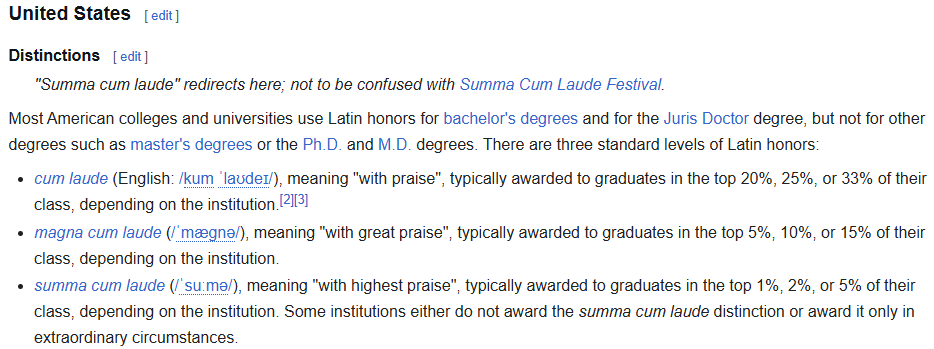
Source: Wikipedia – Latin honors, https://en.wikipedia.org/wiki/Latin_honors
3. Master’s Theses
In this third part, you will discover the three Master’s level research projects that I conducted during my studies at the Sorbonne, LSE and Fudan.
Fudan University
The topic of my 2009 Fudan master’s thesis was “A uses and dependency research on state policies (‘society’), global media consumption (‘media’) and journalistic ideals of media students (‘audience’) in China.” researching through questionnaires the geographical and cultural origins and types of creative content, cultural products and symbolic goods (news, editorials, movies, TV series, videos, music,…) consumed via digital media and the Internet on different devices by the hyperconnected new generation of the country’s best Chinese students
- coming from all the regions of China and from very different economic, social, cultural and educational backgrounds, recently living in an urban and cosmopolitan city like Shanghai,
- on the one hand, influenced and constrained by the policies of the Chinese Government (or the Communist Party of China) like the “Great Firewall”, media censorship and political propaganda but also the emphasis on learning the English language or patriotism in this era of fierce competition between China and the USA for the title of world’s number one superpower (I realized that America is often the only country that China is comparing itself with in any subjects, making me believe in the reality of the US tropism of Chinese elites),
- and on the other hand, inspired by and balanced with Western ideals of freedom of speech and media freedom from Western Europe and North America, also taught in the prestigious Fudan departments of Journalism, Communications, Broadcasting and Advertising for a global approach of the study of traditional and new media, which I consider essential in our increasingly multipolar world.
London School of Economics and Political Science
My 2008 LSE master’s thesis (dissertation) focused on the digitalization and globalization of the cultural and creative industries by interviewing personally some of the most prominent scholars of digital media economics and the socio-economic study of the culture and communication industries, as well as very experienced senior media executives such as the Vice-President and Communications Director of Vivendi or the Director of the European “Telecom, Media & Entertainment” practice of the French consulting firm, Capgemini, a world leader in digital transformation.
Université Paris 1 Panthéon-Sorbonne
I wrote my 2007 Sorbonne master’s thesis (mémoire) on the strategies of media convergence and internationalization of multinational media conglomerates through mergers and acquisitions, taking the example of one of the most powerful French groups, Vivendi, as a monograph.