Author: Guillaume Mariani
AI tool: Claude (Anthropic)
Date: May 2026
Arc 1: The Birth of a Framework
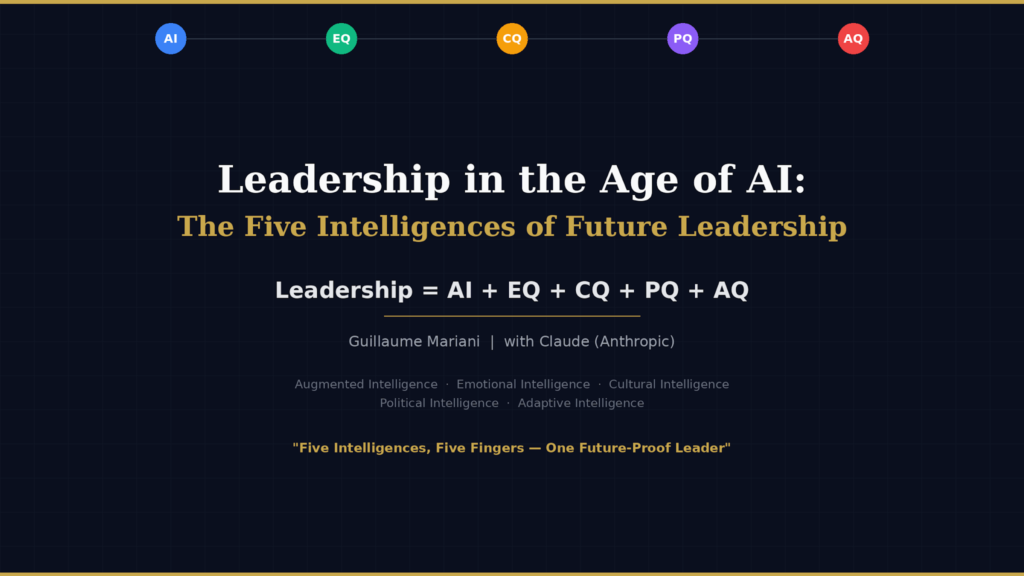
Figure 1. Cover — Leadership in the Age of AI: The Five Intelligences of Future Leadership. © Guillaume Mariani.
Abstract
This article introduces a new interdisciplinary leadership framework for the age of artificial intelligence: the Five Intelligences of Future Leadership. Authored by Guillaume Mariani and developed through extensive dialogue with multiple artificial intelligence systems, the framework proposes that effective leadership in the coming decades can be defined by a five-part formula:
Leadership = AI + EQ + CQ + PQ + AQ
where AI stands for Augmented Intelligence (combining artificial intelligence literacy with cognitive and complexity intelligence), EQ for Emotional Intelligence, CQ for Cultural Intelligence, PQ for Political Intelligence (incorporating purpose as its moral compass), and AQ for Adaptive Intelligence (which subsumes the Judgment Quotient as its highest expression).
The framework is visually represented as the five fingers of a human hand — a mnemonic device designed to make the model memorable and accessible to practitioners, educators, and researchers alike. Each finger corresponds to one intelligence: the thumb (AI), the index finger (EQ), the middle finger (CQ), the ring finger (PQ), and the little finger (AQ).
The Five Intelligences framework makes four central claims. First, leadership in the age of AI requires a new architecture that integrates technological fluency with the full spectrum of human intelligence. Second, humans will not be entirely replaced by artificial intelligence in the workplace, because the most critical leadership competencies are irreducibly human. Third, the social sciences and humanities — long undervalued in business education — are in fact strategic assets for twenty-first-century leaders. Fourth, the skills that will most differentiate exceptional leaders in the coming decades are not technical but relational, cultural, ethical, and adaptive.
The framework is future-proof by design: it ends in adaptability (AQ), ensuring that the model itself evolves as the world around it changes. It is intended as both a conceptual contribution to leadership theory and a practical compass for CEOs, senior executives, entrepreneurs, founders, and business leaders navigating the profound disruptions ahead.
Keywords: future leadership, leadership in the age of AI, Five Intelligences of Future Leadership, augmented intelligence, emotional intelligence, cultural intelligence, political intelligence, adaptive intelligence, AI leadership, human leadership, human-centered leadership, AI-era leadership, leadership theory, future leadership skills, leadership competencies, AI and leadership, human-AI collaboration, augmented leadership, interdisciplinary leadership, social sciences and humanities, leadership development, ethical leadership, adaptive leadership, cultural intelligence in leadership, emotional intelligence in leadership, political intelligence in leadership, AI literacy, complexity intelligence, judgment quotient, purpose quotient, future of work, digital transformation, AI governance, organizational leadership, leadership education, executive leadership, CEO leadership, human irreplaceability, soft skills in the AI era, leadership framework, five-finger leadership model, human hand metaphor.
1. Introduction: The Leadership Deficit of the AI Era
We are living through one of the most consequential technological transitions in human history. Artificial intelligence is reshaping every domain of professional life — from financial analysis and legal research to medical diagnosis and creative production. The question that preoccupies boards, governments, educators, and individuals alike is not merely what AI can do, but what it means for the humans who must work alongside it, govern it, and lead organizations transformed by it.
This question has exposed a significant gap in leadership theory. The dominant models of the past half-century — transformational leadership (Burns, 1978; Bass, 1985), servant leadership (Greenleaf, 1977), authentic leadership (George, 2003), and emotional intelligence-based leadership (Goleman, 1995) — were developed in a world where information was scarce, organizational hierarchies were stable, and the competitive environment changed slowly enough to permit long-range planning. None of these models was designed to address the simultaneous disruptions of artificial intelligence, geopolitical fragmentation, climate instability, demographic transformation, and the accelerating erosion of institutional trust.
The leaders of tomorrow will need to be something genuinely new: technologically fluent enough to govern AI systems without being enslaved by them, emotionally intelligent enough to lead increasingly diverse and anxious workforces, culturally adept enough to operate across fragmenting global markets, politically wise enough to navigate complex stakeholder environments guided by clear purpose, and adaptive enough to learn continuously in a world where the half-life of knowledge is shrinking.
This article presents a framework that names and organizes these demands. The Five Intelligences of Future Leadership — AI, EQ, CQ, PQ, and AQ — offers a new architecture for understanding what leadership means, and what it requires, in the age of artificial intelligence.
2. Theoretical Background and Positioning
2.1 The Multiple Intelligences Tradition
The intellectual ancestry of the Five Intelligences framework draws on several convergent traditions in psychology, management, and organizational behavior. Howard Gardner’s (1983) theory of multiple intelligences challenged the hegemony of IQ as the sole measure of human cognitive capacity, proposing instead a plurality of distinct but related intelligences — linguistic, logical-mathematical, spatial, musical, bodily-kinesthetic, interpersonal, intrapersonal, and naturalistic. Gardner’s insight that intelligence is not a single faculty but a constellation of capacities provides the foundational license for a multi-intelligence approach to leadership.
Daniel Goleman’s (1995) popularization of emotional intelligence (EQ) extended this pluralist perspective into organizational life, demonstrating empirically that EQ predicted leadership effectiveness more reliably than IQ or technical expertise in many professional contexts. Christopher Earley and Soon Ang’s (2003) concept of cultural intelligence (CQ) introduced a cross-cultural dimension, measuring the capacity to function effectively in culturally diverse situations. Robert Sternberg’s (1985) triarchic theory of successful intelligence — distinguishing analytical, creative, and practical intelligence — further legitimized the multi-dimensional view of cognitive capacity.
The present framework builds on this tradition while extending it in three directions: first, by introducing Augmented Intelligence (AI) as a new category that combines artificial intelligence literacy with human cognitive capacity; second, by integrating Political Intelligence as a leadership-specific dimension that has been largely absent from mainstream intelligence frameworks; and third, by positioning Adaptive Intelligence as the meta-intelligence that governs the development of all others over time.
2.2 Leadership Theory in the Digital Age
Recent scholarship has begun to grapple with the implications of digital transformation for leadership theory. Schwarzmüller et al. (2018) identified digital leadership as a distinct construct, emphasizing the need for leaders to develop competencies in technology governance, digital culture, and data-driven decision-making. Schwarzmüller et al. also noted the paradox at the heart of digital leadership: as organizations become more technologically sophisticated, the demand for distinctly human competencies — empathy, judgment, ethical reasoning — increases rather than decreases.
Harari (2018) argued in 21 Lessons for the 21st Century that the most important skills for the twenty-first century are not technical but involve the capacity to handle change, learn new things, and preserve mental balance in unfamiliar situations. This observation aligns closely with the adaptive intelligence (AQ) dimension of the present framework.
The World Economic Forum’s Future of Jobs reports (2020, 2023) have consistently identified a cluster of skills — critical thinking, creativity, emotional intelligence, resilience, and active learning — as the competencies most likely to increase in demand as automation proceeds. The Five Intelligences framework provides a theoretical architecture that unifies and extends these empirical findings.
2.3 The Interdisciplinary Imperative
A distinctive feature of the Five Intelligences framework is its grounding in interdisciplinarity. The framework draws not only on management and leadership theory but on psychology, sociology, anthropology, political science, philosophy, and computer science. This reflects a broader argument: that the challenges facing leaders in the twenty-first century are too complex, too multidimensional, and too unprecedented to be addressed by any single discipline.
The case for interdisciplinary education in business leadership has been made empirically. Studies by the National Association of Colleges and Employers (NACE) consistently rank communication, critical thinking, and teamwork — competencies cultivated primarily through humanities and social science education — as the most sought-after graduate attributes by employers. A landmark study by the Harvard Business Review (2015) found that the CEOs of high-performing companies were more likely to have diverse educational backgrounds spanning the humanities, sciences, and social sciences, rather than purely technical or business training.
The Five Intelligences framework is, in this sense, a vindication of pluridisciplinary education: it argues that the future of leadership will be won by those who can synthesize insights across domains, not those who optimize within a single one.
3. The Five Intelligences Framework
The Five Intelligences of Future Leadership is organized as a formula and a visual metaphor. The formula is:
Leadership = AI + EQ + CQ + PQ + AQ
The visual metaphor is the human hand — one of the oldest symbols of human capability, craft, and connection. Each of the five intelligences corresponds to one finger: the thumb (AI), the index finger (EQ), the middle finger (CQ), the ring finger (PQ), and the little finger (AQ). The hand metaphor is not merely decorative. It communicates three important ideas: that each intelligence is distinct but connected to the others; that the hand (the leader) is only fully functional when all five fingers work together; and that the hand is a human hand — reminding us that the framework is ultimately about human leadership, amplified by technology but not replaced by it.
Figure 4. The Five Intelligences of Future Leadership visually represented as the five fingers of a human hand. Left to right: AI (Thumb), EQ (Index), CQ (Middle), PQ (Ring), AQ (Little Finger).
3.1 AI — Augmented Intelligence (The Thumb)
Definition
Augmented Intelligence is the first and foundational intelligence of the framework. The term is deliberately chosen over ‘artificial intelligence’ to signal that the relevant intelligence here is not the machine alone but the productive synthesis of artificial intelligence and human intelligence. The thumb — the most opposable, the most distinctive digit — represents a capacity that genuinely differentiates leaders: the ability to use AI as a tool, not to be used by it.
Augmented Intelligence integrates three components: (1) artificial intelligence literacy — the ability to understand what AI systems can and cannot do, to govern their deployment ethically, and to interrogate their outputs critically; (2) cognitive intelligence — the capacity for abstract reasoning, conceptual synthesis, and strategic thinking; and (3) complexity intelligence — the ability to hold and navigate multi-variable, nonlinear, and ambiguous situations without premature simplification.
Why It Matters
Every domain of business — finance, legal, human resources, marketing, operations — is being restructured by AI tools. Leaders who fully delegate AI judgment to their technical teams are ceding strategic authority. Those who can ask the right questions of AI systems, set appropriate governance boundaries, recognize the limitations of algorithmic outputs, and make final decisions with informed human judgment are the leaders who will define competitive advantage in the coming decades.
The cognitive and complexity dimensions of Augmented Intelligence are equally critical. In a world of accelerating change and compounding crises — what scholars have termed the ‘polycrisis’ (Lawrence et al., 2022) — the ability to think across systems, hold multiple hypotheses simultaneously, and resist the cognitive comfort of oversimplification is a first-order leadership competency.
“The danger is not that AI will replace human leaders. The danger is that leaders who do not develop AI fluency will be replaced by leaders who have.”
3.2 EQ — Emotional Intelligence (The Index Finger)
Definition
Emotional Intelligence, as defined by Goleman (1995), comprises five components: self-awareness, self-regulation, motivation, empathy, and social skills. In the context of the Five Intelligences framework, EQ represents the relational core of leadership — the capacity to connect authentically with other human beings, to create psychological safety, to build trust at scale, and to sustain the emotional conditions under which people do their best work.
The index finger — the finger we use to point, to direct, to draw attention — represents EQ’s role in leadership: it is the intelligence that orients people, that says ‘this is where we are going and why it matters’ with enough emotional conviction that others are moved to follow.
Why It Matters
As artificial intelligence automates an increasing proportion of analytical and procedural work, the comparative advantage of human leaders lies in precisely those domains where machines are weakest: empathy, authentic connection, ethical judgment, and the creation of meaning. Google’s Project Aristotle (2016) identified psychological safety — a fundamentally emotional construct — as the single most important predictor of team performance across hundreds of teams studied.
In the age of remote and hybrid work, where the informal emotional infrastructure of the office has been partially dismantled, EQ has become even more strategically important. Leaders who can build trust across digital interfaces, sustain morale through uncertainty, and create genuine belonging for increasingly diverse workforces possess a capability that no algorithm can replicate.
“As AI commoditizes analysis, the irreducibly human act of creating and sustaining trust becomes the primary competitive moat.”
3.3 CQ — Cultural Intelligence (The Middle Finger)
Definition
Cultural Intelligence, as defined by Earley and Ang (2003), is the capability to relate and work effectively across cultures. It encompasses four dimensions: cognitive CQ (knowledge of cultural norms and practices), metacognitive CQ (awareness of one’s own cultural assumptions), motivational CQ (the drive to engage with cultural diversity), and behavioral CQ (the ability to adapt behavior appropriately in cross-cultural situations).
In the Five Intelligences framework, CQ is extended beyond its original formulation to include generational intelligence (the ability to lead effectively across the five generations currently present in many workforces), disciplinary intelligence (the ability to collaborate across professional and academic disciplines), and ideological intelligence (the capacity to engage respectfully and productively with diverse worldviews and value systems).
The middle finger — the longest, the most central, the one that anchors the hand’s grip — represents CQ’s role as the connective tissue of the framework: the intelligence that holds diverse people together around a common purpose.
Why It Matters
The global talent market, the multinational supply chain, and the cross-border regulatory environment all demand leaders who can operate fluently across cultural difference. McKinsey’s Diversity Wins report (2020) found that companies in the top quartile for ethnic and cultural diversity were 36 percent more likely to achieve above-average profitability. The business case for cultural intelligence is robust and growing.
At a deeper level, CQ is the intelligence that will determine whether organizations can harness the full creative potential of diverse teams, or whether cultural friction will neutralize that potential. Leaders who mistake their own cultural assumptions for universal truths — who lead globally with a local mind — will systematically underperform those who can genuinely inhabit multiple cultural perspectives.
“In a world of accelerating pluralism, cultural intelligence is not a soft skill. It is a hard competitive advantage.”
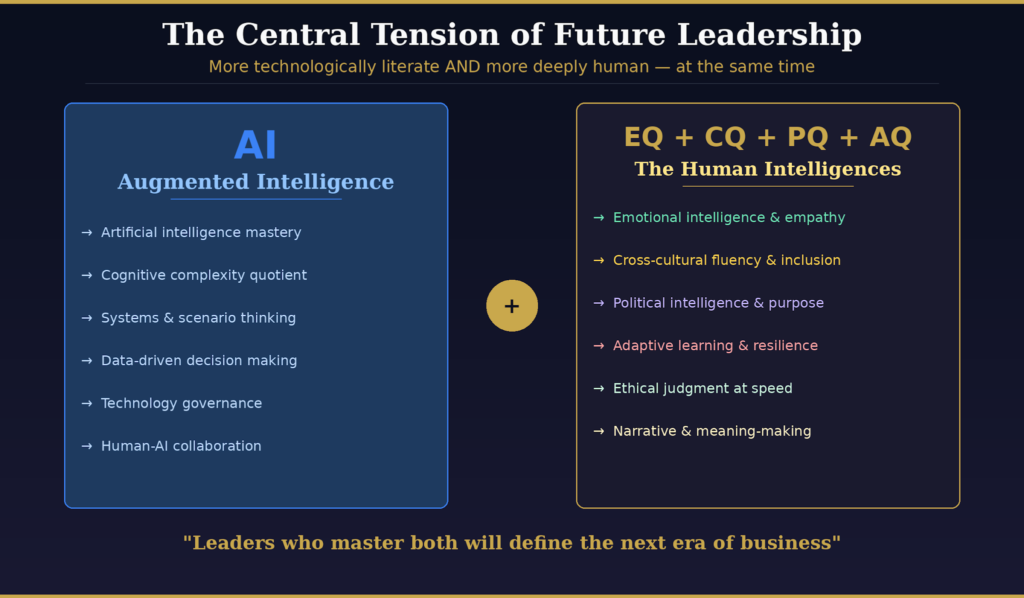
Figure 2. The central tension of future leadership: more technologically literate (AI) AND more deeply human (EQ + CQ + PQ + AQ) — simultaneously. The formula holds both in productive tension.
3.4 PQ — Political Intelligence (The Ring Finger)
Definition
Political Intelligence, as used in this framework, refers not to party-political acumen but to a broader and more fundamental competency: the ability to understand, navigate, and constructively shape the dynamics of power, influence, and stakeholder relationships within and beyond organizational boundaries. Political Intelligence encompasses situational awareness (reading the room, the organization, and the external environment), coalition-building, negotiation, narrative management, and the governance of complex multi-stakeholder systems.
Crucially, in the Five Intelligences framework, PQ incorporates the Purpose Quotient as its moral compass. Political intelligence without purpose degenerates into manipulation; purpose without political intelligence becomes naivety. The ring finger — traditionally the finger of commitment and covenant — represents PQ as the intelligence of principled navigation: power literacy guided by a clear ethical direction.
Why It Matters
The contemporary business environment has expanded the set of stakeholders whose interests leaders must navigate far beyond shareholders. Employees, customers, regulators, civil society, media, and local communities all exert significant claims on organizational behavior. Leaders who lack the political intelligence to map these stakeholder landscapes, build coalitions across them, and communicate with strategic clarity will find their organizations paralyzed by external friction.
At the same time, the integration of purpose into PQ reflects a broader shift in the theory and practice of leadership. Stakeholder capitalism (Freeman, 1984; Fink, 2018) has moved from aspiration to expectation: investors, employees, and customers increasingly demand that organizations articulate and act on a clear sense of purpose beyond profit maximization. Leaders who can authentically embody this integration of power and purpose are positioned to build institutions that are both effective and legitimate.
“Political intelligence without purpose is manipulation. Purpose without political intelligence is naivety. PQ is the intelligence of principled power.”
3.5 AQ — Adaptive Intelligence (The Little Finger)
Definition
Adaptive Intelligence is the capacity to learn continuously, reconfigure mental models rapidly, operate effectively under conditions of genuine ambiguity, and sustain high performance over time despite persistent uncertainty. AQ is the meta-intelligence of the framework: it is what allows leaders to develop and sustain the other four intelligences as the environment changes around them.
Adaptive Intelligence subsumes two additional constructs. The first is the Judgment Quotient (JQ): the ability to make sound, values-aligned decisions under time pressure, with incomplete information, in high-stakes situations. Judgment is the highest expression of adaptive intelligence — it is what distinguishes the experienced leader from the merely competent one. The second is learning agility: the capacity to extract lessons from novel experiences, update beliefs in light of new evidence, and apply insights across domains.
The little finger — the most dynamic, the most expressive, the digit that gives the hand its range and reach — represents AQ as the forward-facing intelligence: always learning, always stretching, always growing. AQ is the intelligence that ensures the framework itself never becomes obsolete, because the adaptive leader continuously revises their understanding of what leadership requires.
Why It Matters
The half-life of business knowledge is shrinking. Strategies that were effective five years ago may be counterproductive today. Technologies that seemed stable a decade ago have been disrupted. Leaders who are deeply attached to past mental models — how markets behaved, how organizations were structured, how competitive advantage was built — will be systematically outperformed by those who can shed and acquire frameworks with fluency and speed.
Moreover, as the pace of change accelerates, the capacity to tolerate and function effectively within ambiguity becomes a first-order leadership competency. Organizations need leaders who can make decisions without complete information, who can hold multiple competing hypotheses simultaneously without premature closure, and who can reverse course with low ego cost when evidence demands it.
“AQ last is the right choice by design. A formula that ends in adaptability never becomes obsolete. #AlwaysLearning #NeverStopLearning”
4. The Architecture of Integration
A central design challenge for any multi-component framework is parsimony: the risk that adding dimensions reduces rather than increases clarity. The Five Intelligences framework addresses this challenge through a deliberate architecture of integration, in which three additional constructs — the Cognitive/Complexity Quotient, the Purpose Quotient, and the Judgment Quotient — are absorbed into the five primary intelligences rather than added as separate dimensions.
Figure 6. The Architecture of Integration: how the Cognitive/Complexity Quotient nests within AI, the Purpose Quotient within PQ, and the Judgment Quotient within AQ — maintaining exactly five intelligences.
4.1 The Cognitive and Complexity Quotient within AI
The Cognitive Quotient and Complexity Quotient are integrated into Augmented Intelligence (AI) because they represent the human amplifiers that transform artificial intelligence from a tool into a genuine strategic advantage. An executive who can access powerful AI systems but lacks the cognitive capacity to formulate the right questions, evaluate the outputs critically, or synthesize the results with wider organizational knowledge, is not using AI — AI is using them. The integration of cognitive and complexity intelligence within the AI finger creates a genuinely augmented intelligence: machine power multiplied by human wisdom.
4.2 The Purpose Quotient within PQ
The Purpose Quotient is integrated into Political Intelligence (PQ) because the relationship between power and purpose is constitutive, not merely additive. A leader’s political intelligence — their ability to navigate stakeholder landscapes, build coalitions, and shape organizational narratives — is morally inert without a clear sense of purpose to guide it. Conversely, a leader’s sense of purpose is politically naive without the intelligence to pursue it effectively in complex institutional environments. By treating purpose as the moral compass of political intelligence, the framework captures the essential unity of these two dimensions: leaders navigate power in the service of purpose, and they pursue purpose through the skilled exercise of political intelligence.
4.3 The Judgment Quotient within AQ
The Judgment Quotient is integrated into Adaptive Intelligence (AQ) because judgment is the highest and most mature expression of adaptive capacity. Judgment is not a static trait — it develops through experience, reflection, and the continuous processing of novel challenges. Leaders who score highly on AQ are leaders who have developed, through sustained adaptive engagement with complex environments, the capacity to make sound decisions even when the situation is unprecedented, the data is ambiguous, and the stakes are high. Judgment is, in this sense, the fruit of lifelong adaptive learning.
5. Why Humans Will Not Be Replaced by AI
The Five Intelligences framework rests on a substantive empirical and philosophical claim: that humans will not be entirely replaced by artificial intelligence in the workplace, and specifically that human leadership is not merely residually necessary but increasingly central as AI capabilities expand. This claim requires careful argument, because it runs against a strand of popular discourse that treats AI displacement as both inevitable and comprehensive.
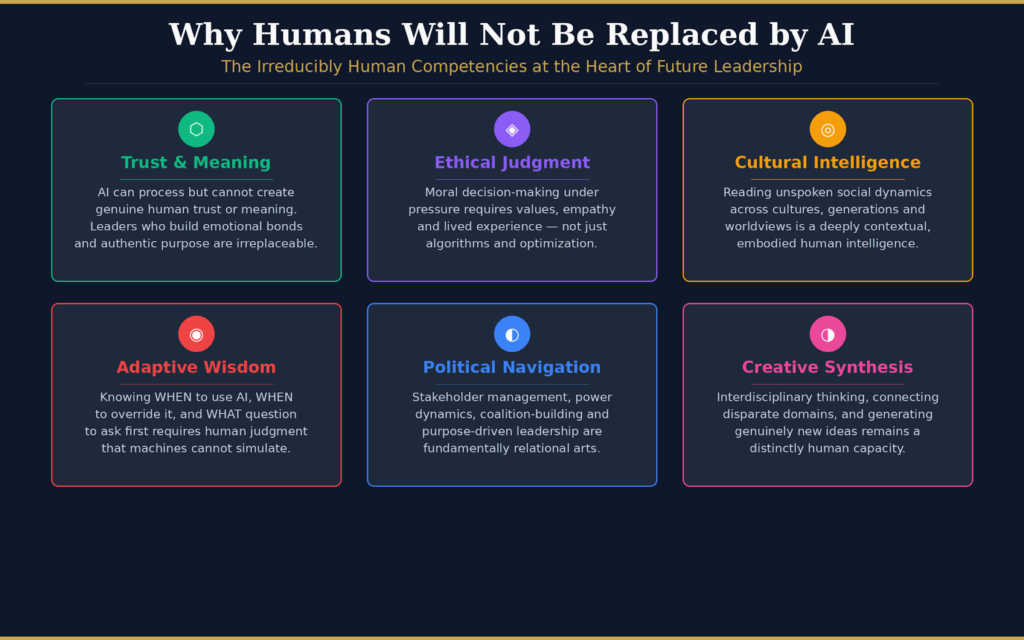
Figure 3. Six irreducibly human competencies that explain why leadership cannot be fully automated: trust and meaning-making, ethical judgment, cultural intelligence, adaptive wisdom, political navigation, and creative synthesis.
5.1 The Irreducibility of Trust
Trust is not a product that can be manufactured algorithmically. It is created through the sustained demonstration of competence, consistency, and genuine care — dimensions of leadership that require embodied human presence and authentic relational engagement. AI systems can simulate trustworthy behavior, but they cannot experience the vulnerability that makes trust meaningful, nor can they bear the moral responsibility that makes it consequential. Leaders who can build and sustain institutional trust across diverse, skeptical stakeholder groups possess a capability that no AI system can replicate, and that becomes more valuable as AI-generated content erodes baseline epistemic trust in public discourse.
5.2 The Irreducibility of Ethical Judgment
Ethical judgment in complex, high-stakes, time-pressured situations requires not merely the application of rules but the integration of values, empathy, contextual sensitivity, and moral imagination. These are capacities that develop through lived experience, relationships, and moral reflection — not through training on historical data. The history of algorithmic decision-making in high-stakes domains — from predictive policing to credit scoring to medical triage — demonstrates repeatedly that AI systems encode the biases and value choices of their designers without the capacity to recognize or correct them through genuine moral agency.
As AI creates new categories of ethical dilemma — around privacy, labor displacement, algorithmic fairness, and the distribution of AI-generated value — the demand for human leaders capable of navigating these dilemmas with wisdom and integrity will intensify, not diminish.
5.3 The Irreducibility of Cultural and Relational Intelligence
Cultural intelligence, emotional intelligence, and the political navigation of complex stakeholder environments all depend on capacities that are fundamentally relational and contextual. They require the ability to read unspoken social dynamics, to respond adaptively to the emotional register of a conversation, to build genuine solidarity across cultural difference, and to hold space for the full complexity of human experience. These are not capabilities that can be reduced to pattern recognition or statistical inference. They are expressions of a distinctly human form of embodied, socially situated intelligence.
5.4 The Irreducibility of Adaptive Wisdom
Perhaps most fundamentally, AI systems optimize for objectives that are specified by humans. They are, in principle, incapable of questioning whether those objectives are the right ones, of recognizing when the rules of the game have changed so fundamentally that the objectives themselves require revision, or of generating the kind of creative, counter-intuitive, cross-domain synthesis that characterizes genuinely innovative leadership. Adaptive wisdom — the capacity to learn from experience in a way that transforms not just behavior but values and understanding — remains a distinctly human achievement.
“The future belongs to leaders who are more human, not less — who use AI to extend their reach while deepening the qualities that machines cannot replicate.”
6. Interdisciplinarity, Social Sciences, and the Humanities
One of the most consequential implications of the Five Intelligences framework is its rehabilitation of the social sciences and humanities as strategic assets for business leadership. In a period when STEM education has been prioritized — sometimes to the explicit exclusion of the humanities — in corporate recruitment and public educational policy, the framework argues that the intelligences most critical for future leadership are precisely those cultivated by disciplines that are often dismissed as impractical.
Emotional intelligence draws on psychology, counseling, and the study of human development. Cultural intelligence draws on anthropology, sociology, comparative literature, and history. Political intelligence draws on political science, philosophy, and the study of ethics. Adaptive intelligence draws on philosophy of mind, behavioral economics, and the study of complex adaptive systems. Even Augmented Intelligence, which includes technological fluency, requires the philosophical capacities for critical evaluation, conceptual synthesis, and ethical reasoning that are the traditional province of the humanities.
The argument is not that technical education is unimportant — clearly, AI literacy requires engagement with technical content. The argument is that technical education alone is insufficient, and that the integrated, pluridisciplinary education that combines STEM with the social sciences and humanities is the best preparation for the demands of future leadership. This is, increasingly, the view of the most forward-thinking business schools and corporate learning departments.
The Five Intelligences framework can be understood as a curriculum in miniature: a map of the intellectual and human capacities that a comprehensive leadership education should develop. AI fluency, emotional development, cross-cultural competence, political and ethical reasoning, and adaptive learning — these are not supplementary electives. They are the core curriculum of future leadership.
7. Practical Implications for Leaders, Organizations, and Educators
7.1 For Individual Leaders
The Five Intelligences framework offers individual leaders a diagnostic tool and a developmental roadmap. By assessing their current capabilities across the five dimensions, leaders can identify their strongest intelligences and their most significant developmental gaps. The framework suggests that truly exceptional leadership requires at least a threshold level of competence across all five intelligences — that deficits in any single dimension will ultimately constrain the leader’s effectiveness, regardless of how high they score on the others.
The framework also suggests a developmental sequence. AI fluency is the most urgent competency to develop for leaders who have not yet engaged seriously with artificial intelligence tools and their governance implications. EQ and CQ development are best pursued through deliberate relational and cross-cultural experiences, combined with structured reflection. PQ development requires immersion in complex multi-stakeholder environments and sustained engagement with ethical and philosophical questions of purpose. AQ development is a lifelong project, best supported by a sustained commitment to learning, intellectual curiosity, and the cultivation of communities of practice that include perspectives from outside one’s professional domain.
7.2 For Organizations
For organizations, the Five Intelligences framework suggests several implications for talent strategy. Recruitment criteria should be broadened to include explicit assessment of EQ, CQ, PQ, and AQ alongside technical competencies. Leadership development programs should be redesigned around the five intelligences, with particular emphasis on the dimensions most neglected by traditional corporate training — cultural intelligence, political intelligence, and adaptive learning.
The framework also has implications for team composition. If each intelligence is valuable and distinct, then leadership teams that collectively span all five dimensions will outperform those dominated by a single type of intelligence. The era of the heroic, individually omncompetent CEO may be giving way to the era of the collectively intelligent leadership team — a team whose members complement each other across the five dimensions of the framework.
7.3 For Business Schools and Educators
For business schools and educators, the Five Intelligences framework is a call to curriculum reform. MBA programs that devote the majority of their instruction to financial analysis, strategy, and operations — while treating ethics, culture, and leadership development as peripheral — are preparing their graduates for a world that no longer exists. The intelligences that will most differentiate future leaders are precisely those that receive the least curricular attention in most business programs.
The framework calls for the genuine integration of social science and humanities perspectives into the core business curriculum: not as optional add-ons but as foundational disciplines. It calls for pedagogical approaches that develop EQ and CQ through immersive cross-cultural experiences and structured reflection, rather than case study analysis alone. It calls for explicit development of political intelligence through engagement with real organizational and societal challenges. And it calls for the cultivation of adaptive intelligence through learning cultures that model curiosity, intellectual humility, and the willingness to update beliefs in light of evidence.
8. Conclusion: The Five-Fingered Future
The Five Intelligences of Future Leadership is a framework for a world in which the most consequential challenges facing leaders cannot be solved by intelligence of any single kind. It is a framework for a world in which artificial intelligence is both a powerful tool and a profound governance challenge. It is a framework for a world in which the diversity of human experience — cultural, emotional, political, adaptive — is not a complication to be managed but a resource to be cultivated.
The formula Leadership = AI + EQ + CQ + PQ + AQ is deliberately simple, because simplicity is a form of respect for the leaders who must remember and apply it under conditions of pressure and complexity. The five fingers metaphor is deliberately embodied, because leadership is ultimately a human practice, enacted by human beings in relationship with other human beings, even as it operates through and alongside increasingly powerful technological systems.
The framework makes a fundamentally optimistic claim: that the future of leadership belongs to humans — not despite the rise of AI, but because of it. As artificial intelligence takes over the tasks that can be automated, it creates space — indeed, it creates an imperative — for the development of the distinctly human intelligences that no machine can replicate. Leaders who develop Augmented Intelligence, Emotional Intelligence, Cultural Intelligence, Political Intelligence, and Adaptive Intelligence are not resisting technological change. They are positioned to lead it.
The hand that holds all five fingers together is the hand of the future leader: augmented by technology, guided by emotion, enriched by culture, directed by purpose, and perpetually in motion — always learning, always adapting, never finished.
“Five intelligences. Five fingers. One future-proof leader.”
Bibliography
Bass, B. M. (1985). Leadership and performance beyond expectations. Free Press.
Burns, J. M. (1978). Leadership. Harper & Row.
Doz, Y., & Kosonen, M. (2008). Fast strategy: How strategic agility will help you stay ahead of the game. Wharton School Publishing.
Dweck, C. S. (2006). Mindset: The new psychology of success. Random House.
Earley, P. C., & Ang, S. (2003). Cultural intelligence: Individual interactions across cultures. Stanford University Press.
Fink, L. (2018). A sense of purpose. BlackRock Annual Letter to CEOs.
Freeman, R. E. (1984). Strategic management: A stakeholder approach. Pitman.
Gardner, H. (1983). Frames of mind: The theory of multiple intelligences. Basic Books.
George, B. (2003). Authentic leadership: Rediscovering the secrets to creating lasting value. Jossey-Bass.
Goleman, D. (1995). Emotional intelligence: Why it can more than IQ. Bantam Books.
Google. (2016). Re:Work — The five keys to a successful Google team. https://rework.withgoogle.com
Greenleaf, R. K. (1977). Servant leadership: A journey into the nature of legitimate power and greatness. Paulist Press.
Harari, Y. N. (2018). 21 lessons for the 21st century. Spiegel & Grau.
Heifetz, R. A., Grashow, A., & Linsky, M. (2009). The practice of adaptive leadership. Harvard Business Press.
Lawrence, M., Homer-Dixon, T., Janzwood, S., Rockström, J., Renn, O., & Donges, J. F. (2022). Global polycrisis: The causal mechanisms of crisis entanglement. Cascade Institute.
McKinsey & Company. (2020). Diversity wins: How inclusion matters. McKinsey Global Institute.
National Association of Colleges and Employers (NACE). (2023). Job outlook: The attributes employers want to see on new college graduates’ resumes. NACE.
Northouse, P. G. (2021). Leadership: Theory and practice (9th ed.). SAGE Publications.
Scharmer, C. O. (2009). Theory U: Leading from the future as it emerges. Berrett-Koehler.
Schwarzmüller, T., Brosi, P., Duman, D., & Welpe, I. M. (2018). How does the digital transformation affect organizations? Key themes of change in work design and leadership. Management Revue, 29(2), 114–138.
Sternberg, R. J. (1985). Beyond IQ: A triarchic theory of human intelligence. Cambridge University Press.
Teece, D. J. (2007). Explicating dynamic capabilities: The nature and microfoundations of (sustainable) enterprise performance. Strategic Management Journal, 28(13), 1319–1350.
Volini, E., Schwartz, J., Roy, I., & Hauptmann, M. (2019). Leading the social enterprise: Reinvent with a human focus. Deloitte Insights.
World Economic Forum. (2020). The future of jobs report 2020. WEF.
World Economic Forum. (2023). The future of jobs report 2023. WEF.
About the Author
Guillaume Mariani is a management scholar, entrepreneur, executive, and educator, and the author and creator of FILE: The Five Intelligences of Leadership Evolution — a management theory and diagnostic framework for leadership and decision-making in the age of AI — and of five original contributions to management, leadership, and the social sciences: a human-centered framework (FILE); a human-centered theory (FILE, FILE³, FILE⁵, FILE⁷, and the 7E Cascade); a human-centered vision (RC — the Relational Commons); a human-centered education (MAIL — Management, AI, and Leadership); and a human-centered methodology (HACK — Human-AI Co-created Knowledge).
The Five Intelligences of Leadership Evolution is the subject of ongoing research and will be developed further in subsequent publications.
Leadership = AI + EQ + CQ + PQ + AQ
© Guillaume Mariani, 2026.