“Teaching is the greatest act of optimism.”
Colleen Wilcox
As early as 1982, Daniel Sabatier (19/03/1938-18/06/2013) created at the Université Paris 1 Panthéon-Sorbonne the world’s first degree in Media Law, Media Economics and Media Management (originally “DESS Droit et Administration de la Communication Audiovisuelle” then “Master D2A – Droit et Administration de l’Audiovisuel” and finally “Master 2 Droit, Economie et Gestion de l’Audiovisuel”). While the first course in media management in the UK appeared at the University of Stirling only in 1993.
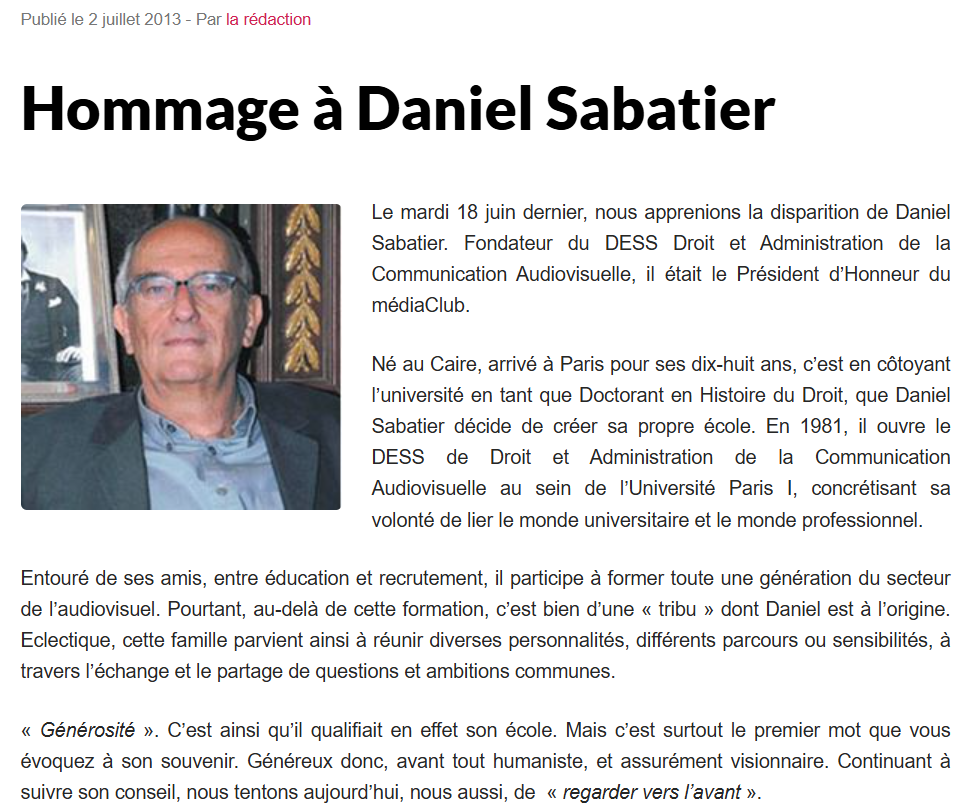
Source: médiaClub (July 2, 2013), Hommage à Daniel Sabatier (page viewed in September 2025).
After high school, I enrolled at the University of Paris 1 Panthéon-Sorbonne in 2002 to pursue the famous “DESS Sabatier” (Sabatier’s Master’s degree), the most famous and recognized program in the audiovisual, media and entertainment industries in France since 1982-1983 (particularly for audiovisual production, film distribution, media marketing, copyright law, program acquisitions, programs development and television programming).
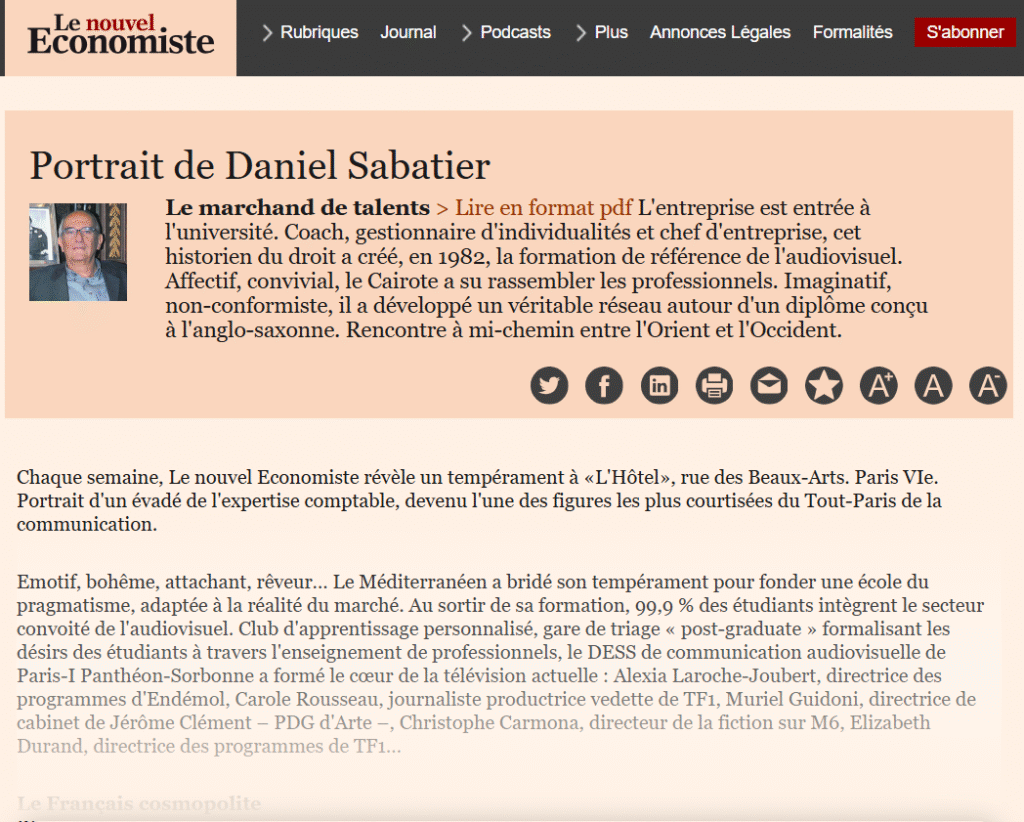
Source: Le Nouvel Economiste (October 17, 2003), Portrait de Daniel Sabatier (page viewed in September 2025).
Each year, the iconoclast, original and pioneer Daniel Sabatier recruited students with very diverse backgrounds for his “DESS” (Master’s degree), creating highly eclectic cohorts. Since high school, I studied the new student cohorts every year: there were students from the best law universities in France (Université Paris 1 Panthéon-Sorbonne and Université Paris 2 Panthéon-Assas), from the best universities for humanities and social sciences (Université Paris 1 Panthéon-Sorbonne, Université Paris 3 Sorbonne-Nouvelle and Université Paris 4 Paris-Sorbonne), from the best communication schools in France (CELSA and Sciences Po Paris), from the best private business schools in France (HEC, ESSEC, ESCP) and from the best public university management programs (MSG Dauphine and MSG Sorbonne, specializing in finance or in marketing). So I decided to enroll in the MSG Sorbonne (the Bachelor of Business Administration at Université Paris 1 Panthéon-Sorbonne) to gain admission to the best media management, media economics and media law program in France: the “DESS Droit et Administration de la Communication Audiovisuelle” at the University of Paris 1 Panthéon-Sorbonne.
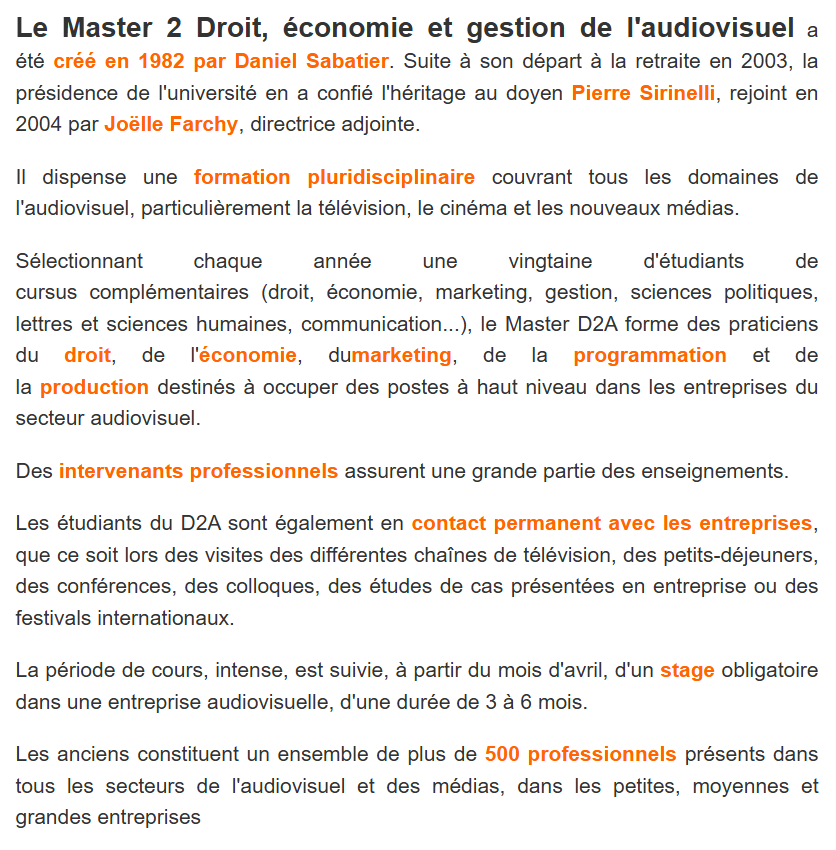
Source: D2A, le film (promotion 2010-2011), Le D2A c’est quoi? (page viewed in September 2025).
There were over 400 applications each year for only about twenty seats. I applied after completing the Sorbonne BBA specializing in marketing followed by the Master’s degree in International Strategic Management at the University of Paris 1 Panthéon-Sorbonne (valedictorian, 2006-2007).
However, when I applied:
- the Master D2A was not digital enough in my opinion and did not adequately address topics related to the digital revolution and the digital transformation of the media and entertainment industry at that precise time (2007),
- the program, then led by two renowned academics in France, Pierre Sirinelli (famous professor of copyright and intellectual and artistic property law) and Joëlle Farchy (famous professor of cultural economics and the economy of the cultural industries), two leading figures in their respective fields, had become more focused on audiovisual law and copyright than before,
- the program was not international enough from my global perspective and there was not a single course in English,
- I had meanwhile been accepted to the brand-new Double Degree in Global Media and Communications at the London School of Economics and Fudan University in Shanghai to be part of the first cohort,
- and most importantly, Daniel Sabatier was gone. He retired in 2003 after training 646 students. The tribe had become orphaned.
Declared an eligible candidate by the selection jury (“admissible”) and invited to attend the final admission interview in 2007, I ultimately declined the invitation, explaining in detail why in a letter, even though it had been my dream for many years to pursue the famous “DESS Sabatier” program and preferring to leave my place to another candidate, and also to ensure that this program would become more digital and international in the future…
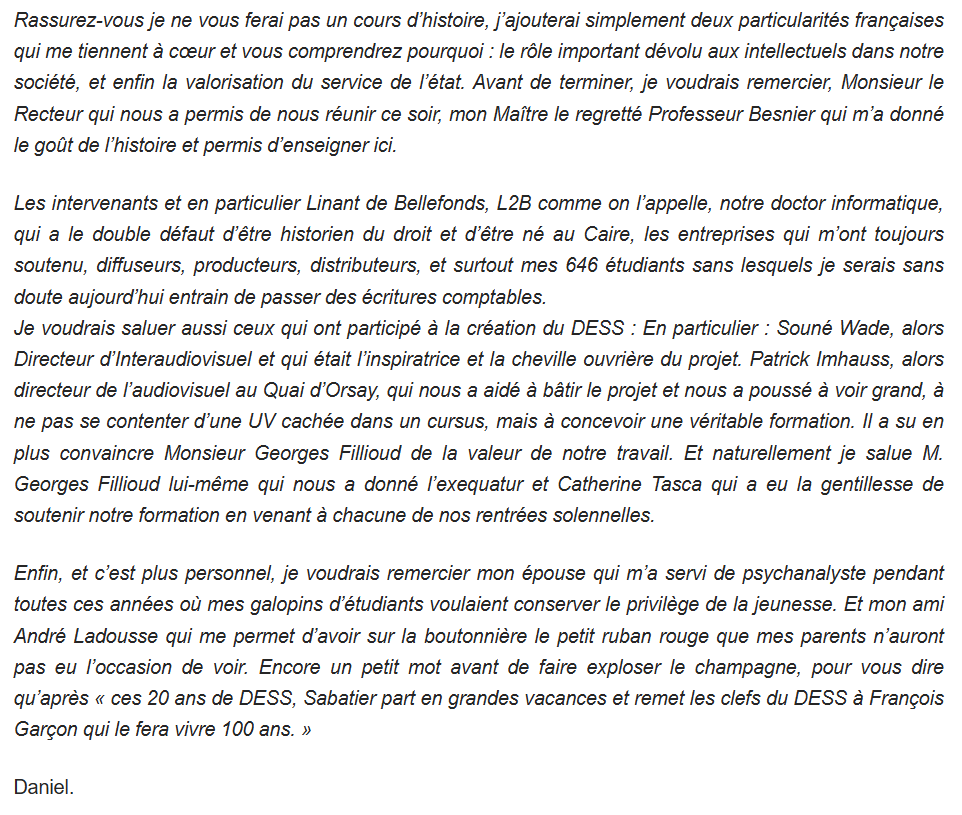
Source: “10 ans après sa disparition : Hommage à Daniel Sabatier, par Jérôme Chouraqui” (médiaClub, June 28, 2023).
The heir chosen by Daniel Sabatier in 2002 to take over his program, François Garçon, was ultimately set aside by the university and replaced by Pierre Sirinelli as the new director of this Master’s degree at the Sorbonne Law School after Daniel Sabatier. So in 2006, François Garçon created his own program reflecting Sabatier’s original philosophy and spirit, the “Master Cinéma, Télévision et Nouveaux Médias”, which later became the “Master DMC – Digital, Médias et Cinéma” attached to the Department of Art History and Archaeology (UFR03) at the University of Paris 1 Panthéon-Sorbonne.
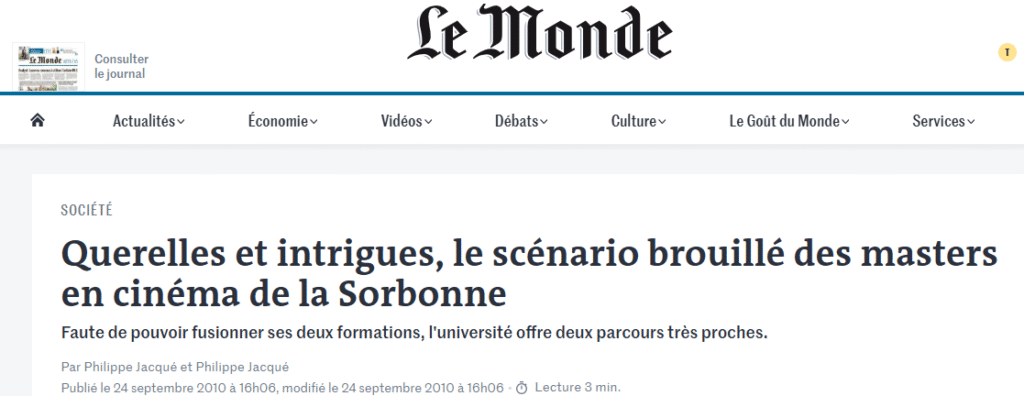
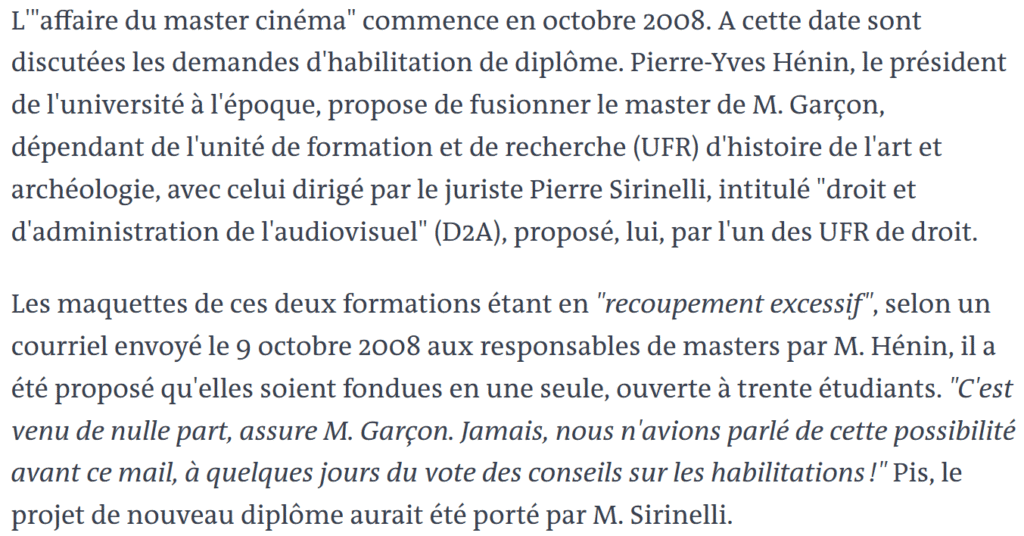
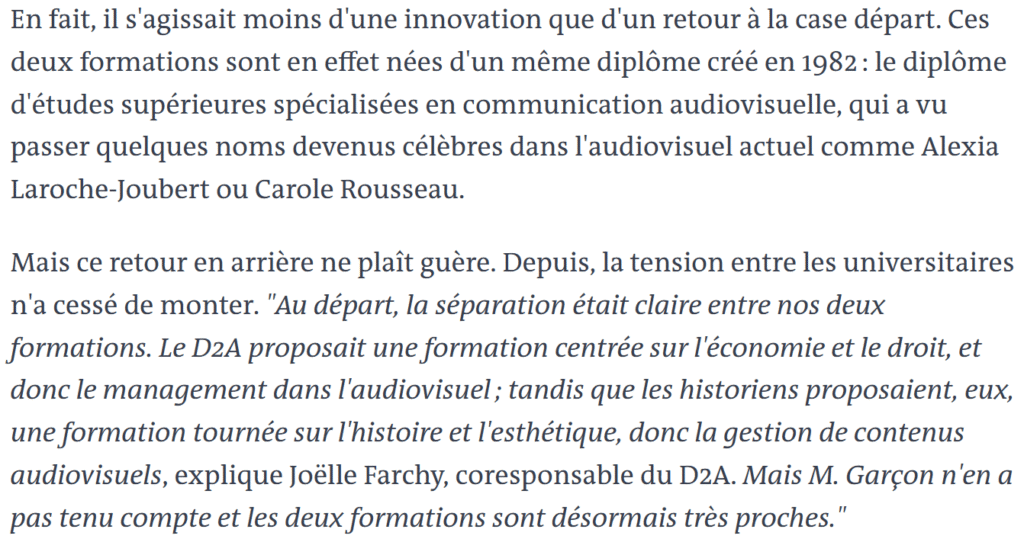
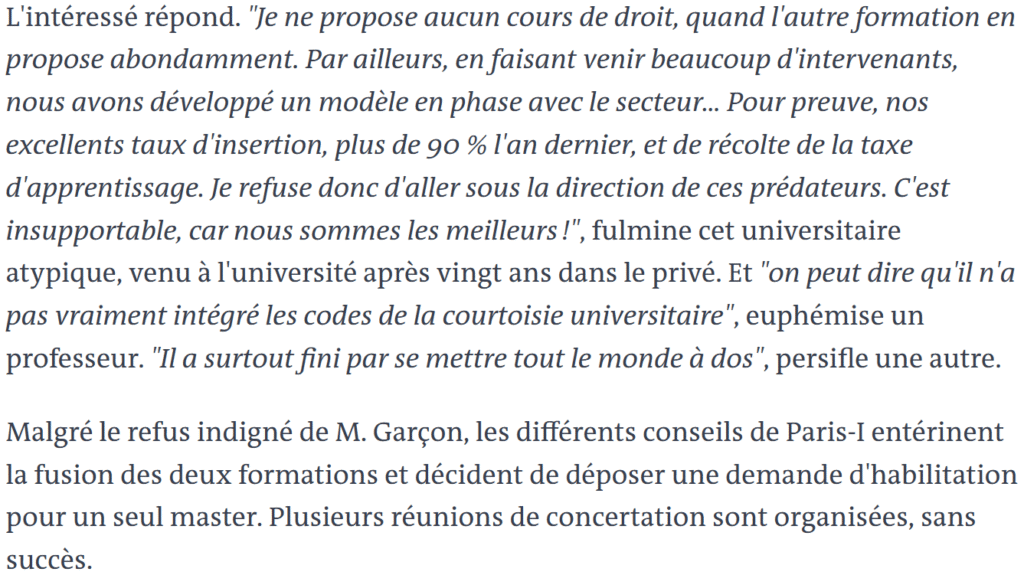
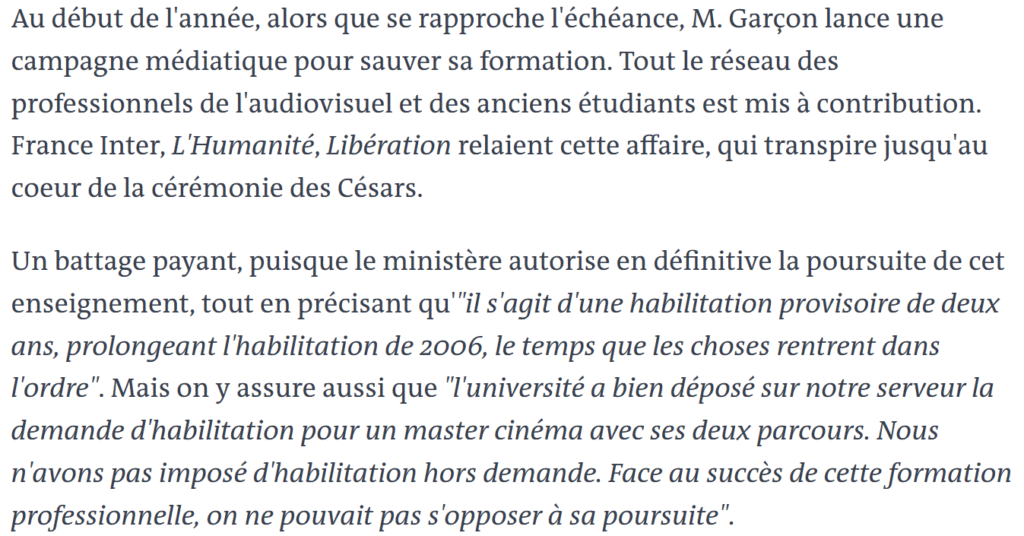
Source: Le Monde, September 24, 2010, “Querelles et intrigues, le scénario brouillé des masters en cinéma de la Sorbonne” by Philippe Jacqué.
Today, these two excellent competing programs are directed by:
- Edouard Treppoz for the “Master Droit, Economie et Gestion de l’Audiovisuel” at the Sorbonne Law School – Paris 1 Panthéon-Sorbonne University.
- Nicolas Brigaud-Robert (alumnus of the DESS Sabatier and one of the 646 “children” of Daniel Sabatier) and Stéphane Goudet for the Master DMC “Master Digital, Médias et Cinéma” at the Sorbonne School of Art History and Archaeology (UFR03) – Paris 1 Panthéon-Sorbonne University.
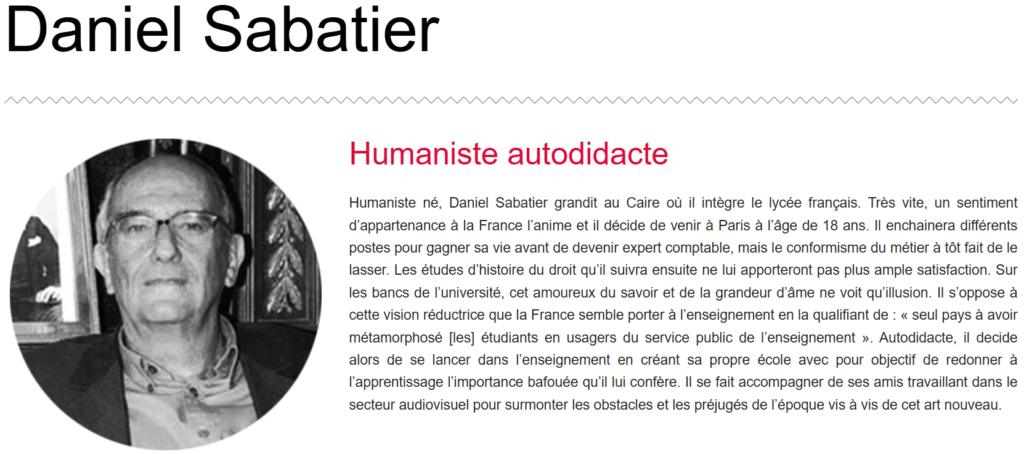
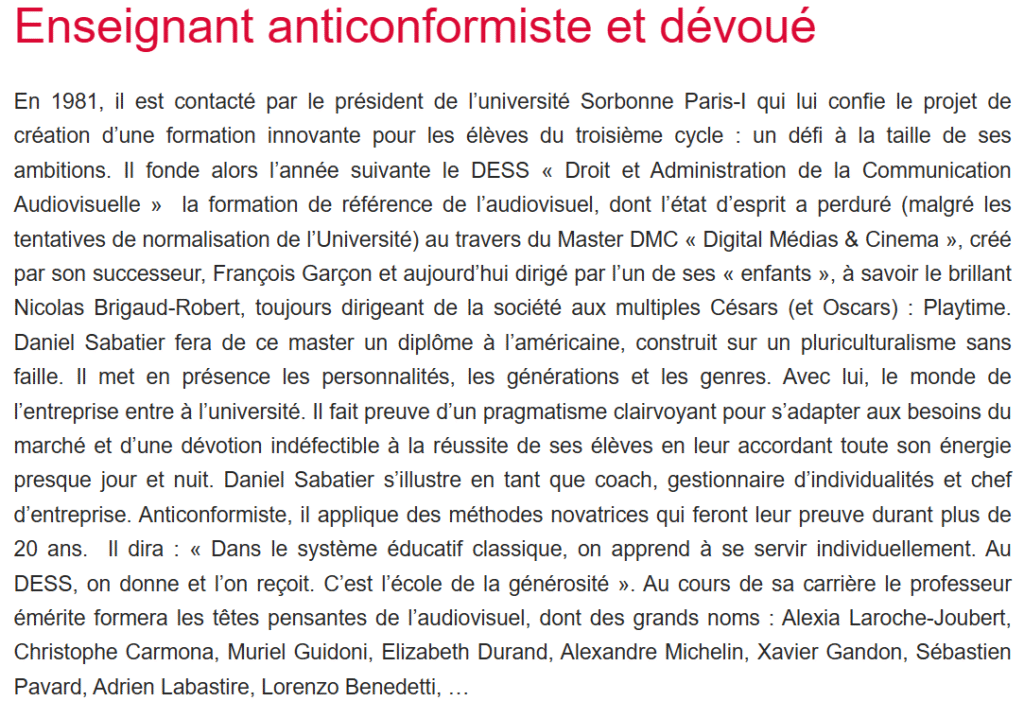
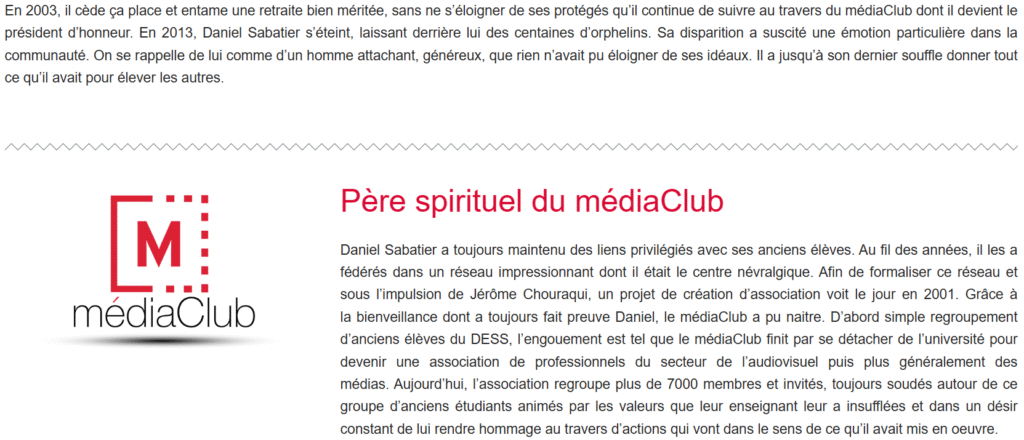
Source: médiaClub, https://www.mediaclub.fr/daniel-sabatier (page viewed in September 2025).